Topic: From rise to decline, the huge media empire that Alibaba invested in seemed to be on the verge of collapse as Jack Ma became speechless.
On January 21, this year’s Laba Festival, Jack Ma, who had been silent for 88 days, spoke for the first time and has been speechless ever since.
It seems that Jack Ma has been "silent" for almost half a year. Along with him, there is also the media empire that he has built with all his heart.
On March 15, the Wall Street Journal reported that Alibaba had been notified to divest the media assets it controls.
As Xu Lin, deputy director of the Propaganda Department of the CPC Central Committee and director of the State Council Information Office, emphasized at the "2020 China New Media Conference": resolutely prevent the party's leadership from being diluted in the name of integrated development, and resolutely guard against the risk of capital manipulating public opinion. ①
I have to say that Jack Ma’s ambition was not just about making money!
From his first investment in the media field in 2009 when he invested in the electronic magazine "Taobao World" to now owning 24 media outlets, Jack Ma quietly built a huge media empire in just 12 years.
However, from Tmall President Jiang Fan’s love affair disrupting the order of online communication, to Ant Huabei’s advertisements encouraging a large number of young people to borrow money and consume in advance, to speeches on the Bund that broke the bottom line of regulators, how far can capital go to control public opinion?
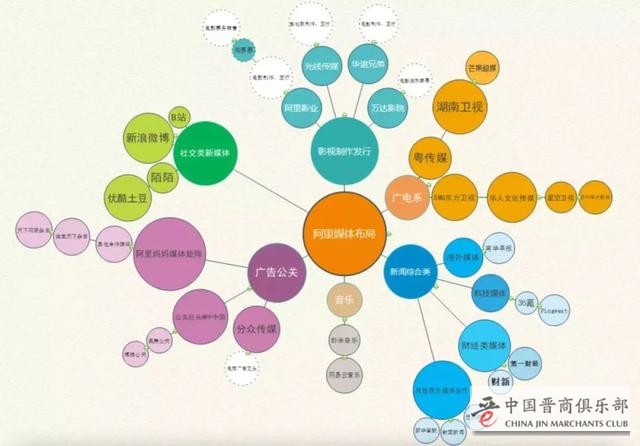
In fact, Jack Ma has taken a fancy to the mass spiritual culture market very early on. Nowadays, many of our spiritual consumptions are inseparable from Alibaba, but the public is not fully aware of it.
For example, Bilibili and Mango TV are popular among young people, "Business Review" is often read by entrepreneurs, "People" magazine is widely read, and movies such as "Wolf Warrior 2" and "Operation Red Sea" that focus on patriotism all have the shadow of Alibaba.
It didn’t take long for Jack Ma to create a huge media landscape——
In 2009, the electronic magazine "Taobao World" was founded. This was Jack Ma's first attempt to invest in the Internet media field. This is another target market in Jack Ma's mind: the media field.
In 2010, Jack Ma and Zhejiang Publishing Group founded "World Online Business". Since then, Jack Ma has begun frequent investment actions, quietly building a huge media asset portfolio, involving online forums, digital media, video websites, film and television production companies, social media, advertising and public relations companies and even traditional paper media and other fields.
In 2012, Jack Ma entered the field of social media for strangers. In July, he invested US$15 million in Momo. A year later, he invested another US$10 million to build Momo, which focuses on social media with strangers.
In 2013, Alibaba took a crucial step and became the second largest shareholder of Sina Weibo with a generous investment of 586 million. In order to successfully acquire a stake in Sina Weibo, the two parties negotiated 46 times, and Jack Ma compromised twice. ②
At the end of 2012, Jack Ma's offer in the early stages of negotiations was to acquire Sina Weibo entirely. However, the offer was fiercely opposed by Sina Chairman Cao Guowei, because Cao Guowei expected to independently list Sina Weibo in 2014-2015. ②
Because Cao Guowei had a tough attitude and left no room for change, Ma Yun made his first compromise. Alibaba subsequently changed the offer from acquisition to holding. Afterwards, Jack Ma suddenly compromised for the second time and agreed to give up the idea of holding a controlling stake, and only entered Sina Weibo as a strategic investor. ②
Sina announced that the two parties will explore a social e-commerce model based on effective interaction between hundreds of millions of Weibo users and hundreds of millions of consumers on Alibaba's e-commerce platform.
Now it seems that Ma Yun's two compromises were worthwhile. Today, Sina Weibo has more than 500 million monthly active users, more than half of China's Internet users. Sina Weibo has also become one of the main platforms for Alibaba to influence and even manipulate public opinion.
In addition, in 2013, Alibaba also became an angel investment institution for "Titanium Media" and "Lianyun.com", which focus on Internet technology investment reports, and made a strategic investment in "Business Review", known as "China's No. 1 Management Journal".
"Business Review" is modeled after the Harvard Business Review edition and is sponsored by the Institute of American Studies, Chinese Academy of Social Sciences. According to its official website, "Business Review" can influence more than 1 million high-end people.
In 2014, Alibaba successfully went public in the United States and became China's second-largest company by market value on that day. Then Jack Ma's investment in the media sector became particularly generous.
This year, Jack Ma made the largest M&A amount in China's Internet industry at that time – HK$6.2 billion. He acquired 60% of the shares of Cultural China and became its largest shareholder. Later, he changed the name of "Cultural China" to "Alibaba Pictures".
In fact, Alibaba Pictures can be seen in many popular movies nowadays, such as "The Wandering Earth", "I'm Not the God of Medicine", "Tomato Rich", "Operation Red Sea", "Wolf Warrior 2", etc. The box office of these movies has exceeded 2 billion yuan, among which "Wolf Warrior 2" has the highest box office of Chinese films – 5.683 billion.
In addition to film and television production, Cultural China also owns traditional paper media "Beijing Times" and mobile game development and other businesses. However, on December 31, 2016, "Beijing Times" announced that it would cease publication and appeared in newsstands for the last time.
In the same year, Alibaba also acquired a 16.5% stake in Youku Tudou for US$1.22 billion, and launched product services for purchasing Youku VIPs on Taobao and Tmall. In addition, it also used a "scratch-off" lottery on the Alipay page to give users trial VIPs.
In 2014, Jack Ma invested in a large number of media platforms, but still refused to give in. So in this year, Alibaba's product team began to build a multi-terminal platform specifically for Chinese enterprises to communicate and collaborate – DingTalk, occupying the corporate social market.
As of 2019, the number of DingTalk users has exceeded 200 million, and the number of enterprise organizations has exceeded 10 million. However, under the impact of the epidemic in 2020, working and studying at home has become the mainstream, and DingTalk has grown by leaps and bounds, occupying the top position in the corporate office field.
In 2014, Jack Ma also teamed up with Shi Yuzhu to acquire 40% of Wasu Media for 6.5 billion yuan. Wasu Media was formerly the Hangzhou Cable Radio and Television Network Center. Until 2017, it was China's only cross-regional cable network operator, with nearly 30 million cable TV home users. ②
In addition, in 2014, Jack Ma and Ping An's Ma Mingzhe jointly invested in Huayi Brothers, with a financing amount of 3.6 billion yuan. Alibaba invested 1.533 billion yuan. After that capital increase, Alibaba became the second largest shareholder of Huayi Brothers. ③
In addition to investments in the film and television field, Jack Ma also focuses on information search and aggregation platforms, wholly acquired Lei Jun's UC Browser, and launched the mobile search engine "Shenma Search".
In 2015, Alibaba spent 2.4 billion yuan to subscribe for 8.8% of Enlight Media's shares, becoming its second largest shareholder.
Enlight Media is a large-scale private media and entertainment group that has flourished in film, television and drama. It owns big IP movies such as "Nezha: The Devil Boy Comes to the World" and "Detective Chinatown", as well as stars such as Zhang Ruonan, Ren Min, and Ding Yuxi. It has good development prospects in the entertainment industry.
In addition to continuing to enter the film and television industry, Alibaba actually invested in these paper media fields in 2015——
In May, Alibaba invested 30 million in Beiqing Community Newspaper, a subsidiary of Beijing Youth Daily.
In June, Alibaba invested 1.2 billion yuan and became the second largest shareholder of China Business News. A strategic investment of US$200 million in China's most influential and complete financial media group – China Business News. ⑤
In the same month, Alibaba also invested in Beijing Boya Tianxia Media and Culture Development Co., Ltd., which owns three magazines: "Blog World", "Financial World" and "People".
In September, Ant Financial invested US$150 million in 36 Krypton, a media company focusing on Internet technology innovation and entrepreneurship.
In October, Alibaba and the Sichuan Daily Newspaper Group's "West China Metropolis Daily" newspaper jointly established "Cover Media". The two parties have joined forces to form a new Cover Media Co., Ltd. and work together to create a new mainstream media that emphasizes "personalized customization". ⑤
In December, Alibaba acquired the Hong Kong newspaper South China Morning Post for HK$2.06 billion in cash. ⑥
The South China Morning Post, founded in 1903, has long been a reading material for Hong Kong's elite. About one-third of its readers are in the United States. Its previous two owners were media tycoon Rupert Murdoch and Malaysia's richest man Robert Kuok. ⑥
By the end of 2015, Jack Ma’s media empire had become relatively comprehensive: it had both traditional television and online streaming media platforms; it had both an Internet new media matrix and traditional paper media with a long history; it had both social platforms and information search and aggregation platforms.
In 2016, Ant Financial invested 20 million yuan in "Caixin Media". According to the official website of Caixin Media: it is committed to China's most influential readership and provides accurate, comprehensive and in-depth financial news and information services. However, according to media reports, in 2019, Ant sold 5.62% of its shares in Caixin Media. ⑥
Also in 2016, Alibaba once again expanded its investment in Sina Weibo, increasing its holdings of Weibo stocks by US$135 million, and its shareholding also increased by 1.4 percentage points.
In 2018, Alibaba entered the offline advertising field and acquired 10.3% of the shares of offline advertising giant Focus Media for 15 billion yuan, becoming the second largest shareholder after founder Jiang Nanchun.
Focus Media's market share in the elevator advertising market is as high as 95%, and its market share in theater screen advertising has reached 55%. Alibaba said that its strategic investment in Focus is an important extension of Alibaba's global marketing matrix. ⑦
In the same year, Alibaba also acquired 12.77% of Wanda Film's shares, becoming Wanda Film's second largest shareholder and continuing to expand in the film and television industry.
In 2019, Alibaba invested US$440 million in Bilibili, accounting for 8% of the total equity. On March 29 this year, Bilibili landed in the capital market for the second time and officially listed on the secondary market in Hong Kong. It can be seen that Alibaba did not make a mistake.
At the end of 2020, Mango Super Media announced that Alibaba had invested more than 6.2 billion yuan in Mango Super Media, a listed company controlled by Hunan Satellite TV, becoming the second largest shareholder.
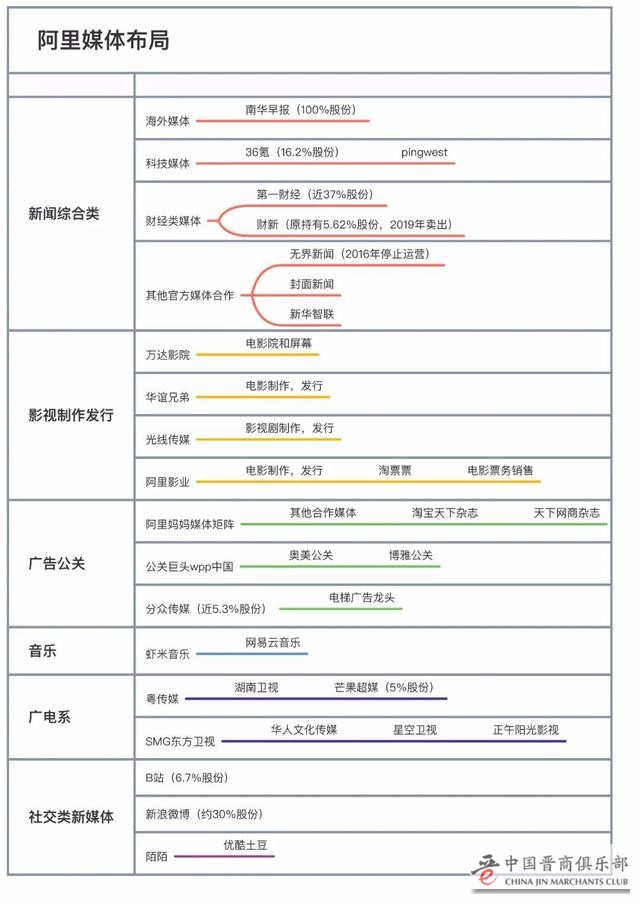
As of now, Alibaba has established a media asset layout covering traditional media, technological new media, information search and aggregation, content distribution, traditional film and television, emerging streaming media, social media and other fields.
In his speech on the Bund on October 24 last year, Jack Ma took his madness to the extreme. Those seemingly "sonorous and powerful" words completely broke the bottom line of regulators and pushed Ant into an "unknown dangerous situation."
One month after the incident, on November 19, 2020, Xu Lin, Vice Minister of the Propaganda Department of the CPC Central Committee and Director of the State Council Information Office, emphasized at the "2020 China New Media Conference": "Resolutely guard against the risk of capital manipulation of public opinion."
Therefore, it is not difficult to understand why the Wall Street Journal reported that Alibaba was asked to sell off the media assets it controls.
Let’s take a look, how are the media companies invested by Jack Ma doing now?
At this year’s 315 party, UC Browser was named for being involved in placing false medical advertisements. In February before that, UC Browser was also publicly named for illegally calling mobile phone permissions.
According to investigation data released by the Guangzhou Municipal Market Supervision Bureau, the party concerned published 608 illegal advertisements for 473 advertisers on the "Shenma Search" platform of UC Browser from March 16, 2019 to March 15, 2021, and collected a total of 13,464.04 yuan in advertising fees.
After the investigation, the Guangzhou Tianhe District Market Supervision Bureau imposed an administrative penalty of confiscating advertising fees of 13,464.04 yuan and a fine of 2,078,172.55 yuan on the parties involved in the case strictly, severely, and expeditiously in accordance with the law. The total amount of fines and confiscations was 2,091,636.59 yuan. ④
Immediately afterwards, major Android app stores such as Huawei, Xiaomi, vivo, and OPPO removed Alibaba's UC Browser from the shelves, displaying "Service adjustment, temporarily not available for download."
Now UC Browser has been re-listed, but it is only a matter of time before UC Browser that operates in violation of regulations will be named next time.
In addition, in the battle for the top market of leading streaming media such as Tencent Video and iQiyi, Youku Tudou has also been defeated and entered the second echelon. In the second echelon, Mango TV will soon surpass Youku Tudou.
In Alibaba's latest financial report for the third quarter of fiscal year 2021 (i.e., the fourth quarter of 2020), Youku's revenue, paid membership and other specific data were not disclosed. It only disclosed that Youku's average daily user base increased by 30% year-on-year. I'm afraid the numbers are not very good.
It can be seen that Alibaba has experienced frequent thunderstorms in recent months, and its business has not been doing well.
Although the above business is indeed not done well, at least it has not completely crossed the bottom line of the people and regulatory authorities. In the incident of "Prince Ali" Jiang Fan, Ali's manipulation of public opinion was undoubtedly exposed as a capitalist.
Jack Ma once said this: "If any business affects the media's correct judgment and independent thinking, this society will be in chaos. The media cannot be allowed to fall, the media cannot be allowed to lose themselves, and the media cannot be allowed to lose objective and rational communication because of money. This is also the reason why we entered Weibo, we can help them technically."⑧
Jack Ma also said: "We never interfere in any operation of any media, because this is what I feel I need to respect the news." ⑧
The words are so beautiful. The purpose of entering Weibo is "to prevent the media from losing objective and rational communication because of money." But is this really the case?
In April last year, the first wife of Tmall CEO Jiang Fan posted on Weibo that she was cheating on her, Internet celebrity Zhang Dayi, and asked Zhang Dayi to stay away from her husband.
Jiang Fan's love affair quickly spread on Weibo, attracting many people to watch, but obviously, Ali's subsequent series of operations immediately put behind Ma Yun's beautiful words.
Shortly after the Weibo post calling out Zhang Dayi was posted, Jiang Fan's wife's Weibo comment function was blocked. At the same time, some Weibo users found that their relevant posts were deleted by the platform, and all related topics disappeared thereafter.
It is worth mentioning that this account (Business Master Research Institute) once published a post titled "Tmall President's Deletion of Posts Related to Cheating: Challenging Jack Ma's Values?" ", "The wife of Taobao CEO is tearing up the mistress: Will the person who deletes the post not go to jail? ", respectively commented on "Alibaba's rapid deletion of Weibo posts involving the incident". However, these articles posted by major business groups on Weibo and some self-media platforms invested by Alibaba were also quickly deleted.
Although Jiang Fan's wife was later settled and Weibo returned to its peaceful appearance, how could the country not take action by manipulating public opinion so wantonly?
In June 2020, the Cyberspace Administration of China interviewed the person in charge of Sina Weibo and pointed out that Sina Weibo had interfered with the order of online communication and disseminated illegal information during the public opinion incident involving Tmall President Jiang Fan, requiring it to make immediate rectifications and suspend updating the hot search list for a week. At the same time, the relevant responsible persons will be dealt with seriously, and Sina Weibo will be subject to strict administrative penalties of fines in accordance with the law.
It was also from the content of this announcement that netizens realized the horror of capital controlling public opinion.
Jack Ma's public relations team can grasp the direction of public opinion, silence a large number of Weibo influencers for money, use money to delete public comments, and even close channels for public discussion. How terrifying this is.
In addition to this, Alibaba has used its media assets as a tool to control public opinion and has also successfully influenced public perceptions of the emerging fintech industry.
Huabei once launched such an advertisement. The content of the advertisement was about a female college student who borrowed Huabei to travel across the country after graduation. In addition, another Huabei advertisement also promoted a poor father who borrowed money from Huabei to celebrate his daughter’s birthday in style.
Whether it is a loan for a graduation trip or a loan for a birthday, these advertisements convey extremely wrong values, but they accurately capture the vanity of young people and successfully guide a large number of young people to consume in advance.
When everyone was complaining about overtime work, Jack Ma blurted out that "996 is a blessing." Although his true identity has been revealed, thanks to his media and public relations matrix, Jack Ma still has the title of "Daddy Ma" given to him by consumers.
Fortunately, this evil trend that encourages the public to consume in advance has been stopped by the regulatory authorities. Just when Ant’s listing was urgently stopped, its Huabei advertisement was also removed overnight.
Therefore, the "Wall Street Journal" report that Alibaba was asked to sell off the media assets it controls is not sudden…
In 2013, Alibaba Entertainment was established, and Jack Ma gave it an eleven-year period.
During this period, Alibaba Entertainment set a new record for internal corruption within the Alibaba Group.
In July 2015, Liu Chunning, the former vice president of Alibaba Pictures, was taken away by the Shenzhen police on suspicion of commercial bribery; in 2016, Lu Fanxi, the vice president of Youtu, was found to be involved in corruption by the public security organs and was detained; in 2016, Kong Qi, the vice president of Alibaba Pictures and general manager of Taopiaopiao, was suspected of corruption and bribery; in December 2018, Yang Weidong, the top rotating president of Alibaba Entertainment, accepted bribes and was sentenced to seven years in prison and had 2 million yuan in property confiscated. ⑨
Declining performance losses and internal corruption have resulted in Alibaba's media sector being large but not strong. Faced with continuous losses in many businesses, Jack Ma seems to have no time to wait for them to turn losses into profits.
Although the media matrix that Jack Ma has spent more than ten years laying out has penetrated into all aspects of public spiritual consumption, Alibaba can only choose to get rid of such a huge market share. At the same time, the losses and risks associated with it are also all-round –
First of all, Alibaba’s e-commerce platforms such as Taobao and 1688 will lose a large number of promotion channels. Originally, products have the dual convenience of internal promotion and external promotion of Alibaba platforms. This convenience may be suspended in the future.
Secondly, in the Alibaba media sector, the Hong Kong-based South China Morning Post English media and the mainland's China Business News, People, Finance World and other print media, because of their great influence and large personnel organizations, under our country's insistence on the principle of party-controlled media and the requirements of politicians running newspapers, they must be completely divested, even if the procedures are complicated, time-consuming and labor-intensive, and they suffer losses for months.
Finally, Alibaba's divestiture of media assets has also affected a wide range of companies, such as Sina Weibo, Mango Super Media, Focus Media and other companies in which Alibaba holds large shares. Future decisions and plans may even change as a result. Whether Youku Tudou, which has suffered continuous losses and was "enriched" by Ali, can continue to survive in the future after being divested will be a question.
However, some people believe that after this adjustment, Ali's giving up some non-core assets is an opportunity. In the future, Ali can be more focused and stable, focusing on more core businesses; and for the media assets it has divested, getting rid of Ali will have a higher degree of freedom, and may also be able to develop better.
However, media assets are always the traffic diversion entrance and public relations tool for other Alibaba businesses, so it would be a pity to sell them off.
Perhaps in the future Alibaba will use another method to hold some media assets in disguise, which is also unknown.