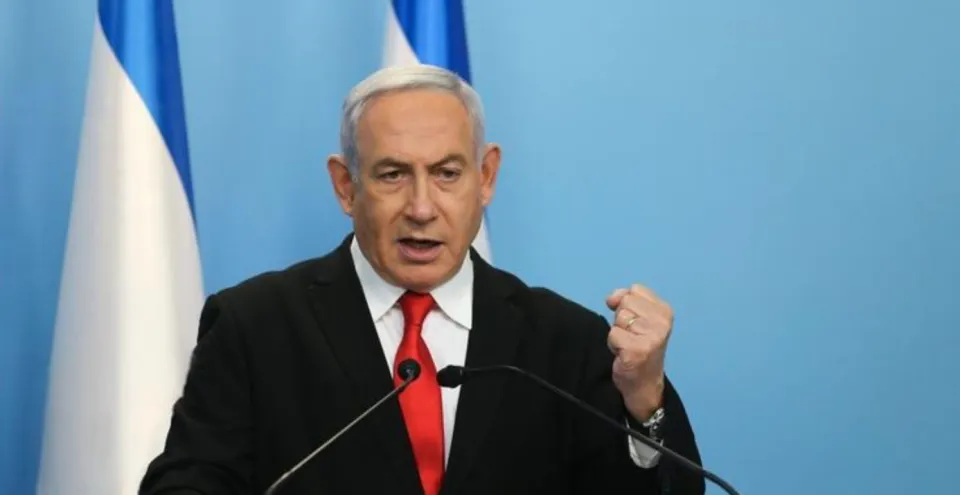
When I woke up, I found a piece of news that had been going viral on the Internet.
The news is that Netanyahu may have been injured or even killed.
Why is this news spreading?
Some media reported this news mainly for three reasons:
First, it was nearly three days ago that Netanyahu’s personal channel released the last video and nearly four days ago that he released the last batch of photos. Since then, the few statements issued in his name have been in text form. Previously, his personal channel usually posted at least one video a day, sometimes as many as three; second: some Hebrew sources reported that there were reports on March 8 that security alerts around Netanyahu's residence had been tightened, especially to guard against potential suicide drones; third: It was said that US President Trump's son-in-law Kushner and Trump's special envoy Witkov were originally scheduled to visit Israel on the 10th, but the plan was cancelled.
So, is Netanyahu really dead?
Today we will talk about this issue.
In fact, if you want to quickly judge whether a news report is "authoritative news," the fastest way, which is also a rough judgment method, is to look at the media that reported the news, which authoritative media reported it, and whether the number of media reported the news was greater or less.
So, what media outlets are currently reporting on Netanyahu’s injury or even death?
After checking, I found that on Weibo, there are currently only two media reports:
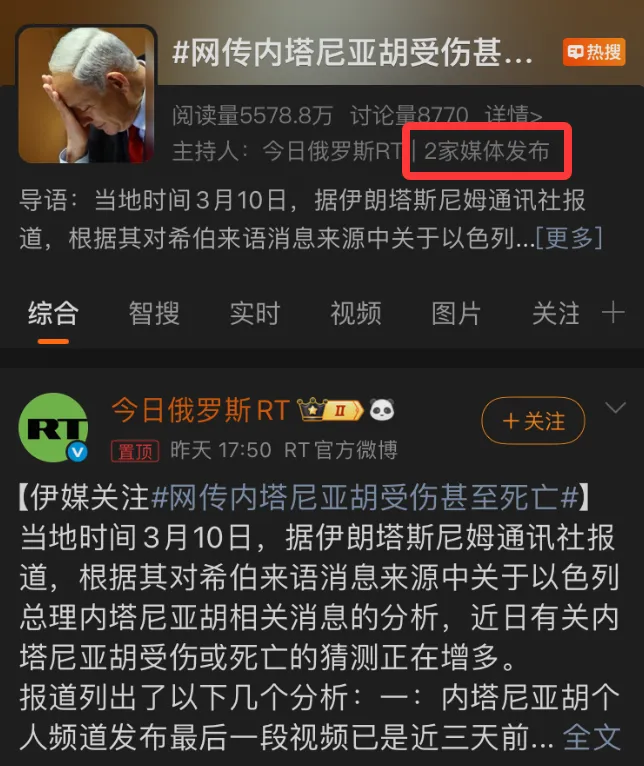
They are these two:

If this news has not been published by our domestic Xinhua News Agency or People's Daily, or even newspapers such as the Global Times, then this probably means that this news should be doubtful at present.
Because newspapers, especially authoritative newspapers, rely on credibility. If they collectively do not publish a piece of news that is widely circulated, it at least means that they are not willing to use their credibility to endorse the news.
So, if a place is in a special state and the information is not transparent, how should we judge whether a public figure is gone?
In fact, in modern society, most organizations have a template for dealing with this kind of news.
Let's assume that if one village (Village A) says that the village chief of another village (Village B) is dead, then Village B wants to prove that its village chief is not dead. So in modern society, how should Village B generally deal with this kind of thing?
In modern society, Village B who wants to refute rumors usually do four things.
1. Arrange for the village chief to show his face on the spot, and deliberately reveal the time and date.
That is to ask the village chief to go directly to the village entrance, the square, or the brigade headquarters, stand in a place with time characteristics (such as the station schedule, under the clock in the square), talk, move, and do things in front of everyone, so that everyone can see the living person with their own eyes. This is the most important routine operation, because this routine operation can best prove that the village elder is fine, and it is more effective than anything else.
2. Officials from the village came forward to confirm.
After encountering such rumors, the second step is that the village brigade and village cadres will come out to speak about the matter, or post notices, endorse with their own credibility, and tell the villagers: "The village chief is doing fine and is currently handling village affairs. Saying that the village chief is gone is just a rumor." If these endorsements are accompanied by official seals and videos, then these words will have greater credibility at this time.
3. The village chief does the village chief's work as usual.
What the village chief still has to do at this time is to follow the appointment process and do his own work—meetings should be held according to the schedule, mediation should be done, and signatures should be signed. He should use his normal work to tell the residents and people around him that the village chief is there and has the power. He is still working according to the daily appointment process.
4. The external communication department of the village personally came out to point out that it was a rumor.
The last step is for the village's external communication department to come out and tell the villagers: Village A is spreading nonsense. They have no photos, no witnesses, and no real evidence, so please don't follow the rumors.
The above is a template for how most organizations currently respond to this kind of news.
But the strange thing is that regarding Netanyahu, Israel has not followed the above four steps. They have not let the village chief himself show up on the spot, and they have not given the time or date of the village chief’s latest appearance. No authoritative department or figure in the village has come out to say this. They have only given out some recent written statements of the village chief. So what does this mean?
It stands to reason that in this case, the village chief should come forward in person, which is the most powerful witness. However, they only gave a written statement – not appearing on camera to refute the rumors, only giving a statement. This probably means that the village chief's current situation is not suitable for him to come forward, and this may also mean that the village chief is probably between "injury" and "death".
Specifically – the village chief was not dead, but was injured, and it was not a minor injury, so he was not suitable to come forward – I think this possibility is relatively high.
And if the head of a village (Village A) is injured in a battle with (Village B), what does this mean?
This could mean several things.
① Village B has the actual combat ability to accurately attack the highest level of Village A. They are not as weak as imagined and cannot underestimate the enemy;
② There are fatal loopholes in the security system of Village A, and the intelligence agency may also have problems, or there may be major internal leaks;
③ If the leaders of both sides of the war are threatened, then the retaliatory actions will escalate, and the expansion of the war is likely to be inevitable…
So what does this mean?
This actually illustrates one thing – any war forces the warring country to expose all its weaknesses, shortcomings, and hidden diseases to its opponents and the world at once – weaknesses and shortcomings that appear in peace can make a country strong; while weaknesses and shortcomings that appear in war can easily cause a country to perish, because only by not fighting can a country have the opportunity to quietly make up for its shortcomings.
Therefore, true strength is never "I dare to fight", but "I have the ability to avoid fighting in the face of threats" – relying on the ability to hold peace to prevent others from messing with you, while secretly developing and making up for your shortcomings, this is the highest level of strength…