On March 10, Nvidia CEO Jensen Huang published a rare long blog post on artificial intelligence on Tuesday, pointing out that the current AI infrastructure construction is still in a very early stage. He emphasized that although the industry has invested hundreds of billions of dollars so far, trillions of dollars of continued investment will be needed in the future to improve data centers and related underlying facilities. This is his seventh long public article since 2016, explaining his views on the development speed, access rights and governance model of AI.
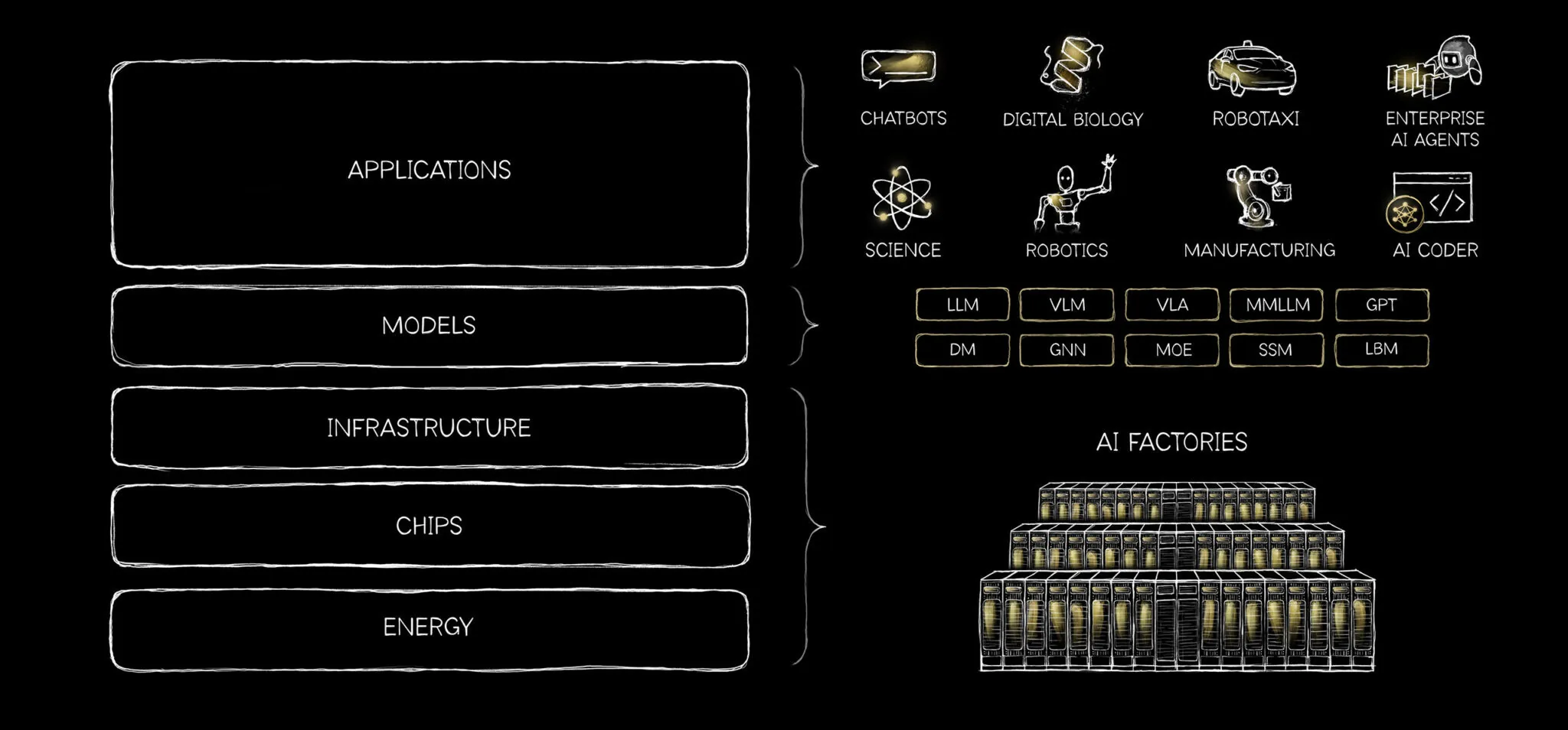
In the article, Huang Renxun defined AI and traditional technology, pointing out that AI has broken the operating model of traditional software. He believes that traditional software only extracts stored instructions pre-written by humans, while current AI systems can perform real-time reasoning based on context and generate intelligence on demand. In order to clarify the industrial structure, he once again mentioned the "five-layer architecture" model he proposed at the Davos Forum at the beginning of the year, clearly stating that the AI ecosystem consists of energy, chips, infrastructure, models and applications from bottom to top. Any successful upper-layer application must completely rely on the continuous support of underlying facilities and even power plants.
Regarding the impact of technological development on the labor market, Huang Renxun believes that AI will not reduce jobs, but will create a large number of new job opportunities, especially in the fields of infrastructure and skilled technical work. His logic is that when AI takes over the daily routine tasks of an enterprise, the increase in productivity will be transformed into an expansion of service capabilities, which will in turn drive substantial growth and expansion of the enterprise. He concluded that at present, a large number of underlying facilities have not yet broken ground, and the supporting labor force has not yet completed training. The real dividend period and large-scale construction of the AI industry have just begun.
The following is the full text of Huang Jenxun’s blog:
AI is a five-layer cake
Jensen Huang
March 10, 2026
AI is one of the most powerful forces shaping the world today. It's not just a smart app or a single model; it's infrastructure as critical as electricity and the Internet.
AI runs on real hardware, real energy, and real economics. It takes raw materials and turns them into intelligence at scale. Every company will use it. Every country will build it.
To understand why AI is developing in this way, we need to start from first principles and see what fundamental changes have occurred in the field of computing.
From pre-programmed software to real-time intelligence
For most of the history of computing, software was pre-written. Humans write the algorithms and computers execute them. Data must be carefully structured, stored in tables, and retrieved with precise queries. SQL is indispensable because it makes that world possible.
AI breaks this mold.
For the first time, we have computers that can understand unstructured information. It can see images, read text, hear sounds and understand meaning. It can reason about context and intent. Most importantly, it generates intelligence in real time.
Every response is generated fresh. Every answer depends on the context you provide. This is no longer software that retrieves stored instructions, but software that can reason and generate intelligence on demand.
Precisely because intelligence is produced in real time, the entire computing architecture stack underlying it must be reinvented.
AI as infrastructure
When you look at AI from an industrial perspective, it appears as a five-layer architecture.
Level 1: Energy
At the bottom is energy. Intelligence generated in real time requires power generated in real time. Each token generated is the result of electron movement, heat management, and energy conversion into computing power. There are no layers of abstraction below this. Energy is the first principle of AI infrastructure and the absolute constraint on how much intelligence the system can produce.
Second layer: chip
On top of energy are chips. These processors are designed to convert energy into computing power at scale and in an efficient manner. AI workloads require extremely large parallel computing power, high-bandwidth memory, and fast interconnects. The progress of the chip layer determines the expansion speed of AI and the degree to which the cost of intelligence decreases.
The third layer: infrastructure
Above the chip is the infrastructure. This includes land, power delivery, cooling systems, building construction, networks, and systems that orchestrate thousands of processors into a single machine. These systems are “AI factories.” They are not designed to store information, but to create intelligence.
The fourth layer: model
On top of the infrastructure are models. AI models can understand many types of information: language, biology, chemistry, physics, finance, medicine, and the physical world itself. Language models are just one category. Some of the most transformative work is happening in areas such as protein AI, chemical AI, physics simulation, robotics, and autonomous systems.
Level 5: Application
At the top is the application, where economic value is created. Drug discovery platforms, industrial robots, legal assistants, self-driving cars. A self-driving car is an AI application embodied in the machine, while a humanoid robot is an AI application embodied in the body. Same underlying architecture, different application output.
This is the "five-layer cake" architecture: energy → chip → infrastructure → model → application.
Every successful application pulls up every layer below it, all the way to the power plants that keep it running.
Our construction has just begun. We have only invested hundreds of billions of dollars so far, and there are still trillions of dollars worth of infrastructure waiting to be built.
Around the world, we are seeing chip factories, computer assembly plants, and AI factories rising on an unprecedented scale. This is shaping up to be the largest infrastructure development in human history.
The labor force required to support this construction was enormous. AI factories need electricians, plumbers, plumbers, steelworkers, network technicians, installers and operators.
These are high-skilled, high-paying jobs, and demand currently exceeds supply. You don’t need a PhD in computer science to participate in this transformation.
At the same time, AI is driving productivity improvements across the knowledge economy. Taking radiology as an example, AI can now assist in reading scans, but the demand for radiologists continues to grow. This is not a paradox.
A radiologist's core responsibility is to care for patients, and reading scans is just one task in the process. When AI takes over more routine tasks, radiologists can focus on clinical judgment, doctor-patient communication, and patient care. As hospitals become more productive, they can serve more patients and hire more staff.
Productivity creates service capacity, and capacity creates economic growth.
What has changed in the past year
Over the past year, AI has crossed an important threshold. The model becomes good enough to play a substantial role in large-scale applications. Reasoning abilities are improved, hallucinations are significantly reduced, and grounding accuracy is significantly improved. For the first time, applications built on AI are starting to generate real economic value.
Applications in areas such as drug discovery, logistics, customer service, software development and manufacturing have demonstrated strong Product-Market Fit. These applications are pulling hard on every layer of structure beneath them.
The open source model plays a key role in this. Most models in the world are free. Researchers, startups, large enterprises, and even entire countries rely on open source models to participate in the development of advanced AI. When open source models reach cutting-edge levels, they not only change the software itself, but also activate the need for the entire architectural stack.
DeepSeek-R1 is the best example. By making powerful inference models widely available, it accelerates technology adoption at the application layer and correspondingly increases its underlying requirements for training, infrastructure, chips, and energy.
what does that mean
When you consider AI as essential infrastructure, its far-reaching impacts become clear.
AI starts with the Transformer large language model. But it's much more than that. It is an industrial transformation that will reshape how energy is produced and consumed, how factories are built, how work is organized, and how economies grow.
The reason why AI factories are built is because intelligence is now generated in real time; the reason why chips need to be redesigned is because efficiency determines the speed of intelligence expansion; the reason why energy becomes the core is because it sets the upper limit of the total amount of intelligent production; the reason why applications are accelerating is because the underlying model has crossed the threshold and can finally be truly effective at scale.
Each layer reinforces the other.
That’s why this infrastructure push is so huge, why it touches so many industries simultaneously, and why it’s not limited to a single country or sector. Every company will use AI. Every country will build it.
We're still in the early stages. Much of the infrastructure has yet to be built. Large swathes of the workforce have yet to receive training. Many opportunities remain untapped.
But the direction is very clear.
AI is becoming a fundamental infrastructure of the modern world. And the choices we make now—how fast we build, how broadly we engage, and how responsibly we deploy—will ultimately shape the future of this era.