March is here again, and many people’s Moments are flooded with all kinds of flowers.
If you go to the forest and the flowers are blooming, you will be a flower-watcher when you go out. Flower-viewing and spring outings have been around since ancient times, and now cherry blossoms, rapeseed flowers, and tulips have become spring standards and traffic codes in many cities.
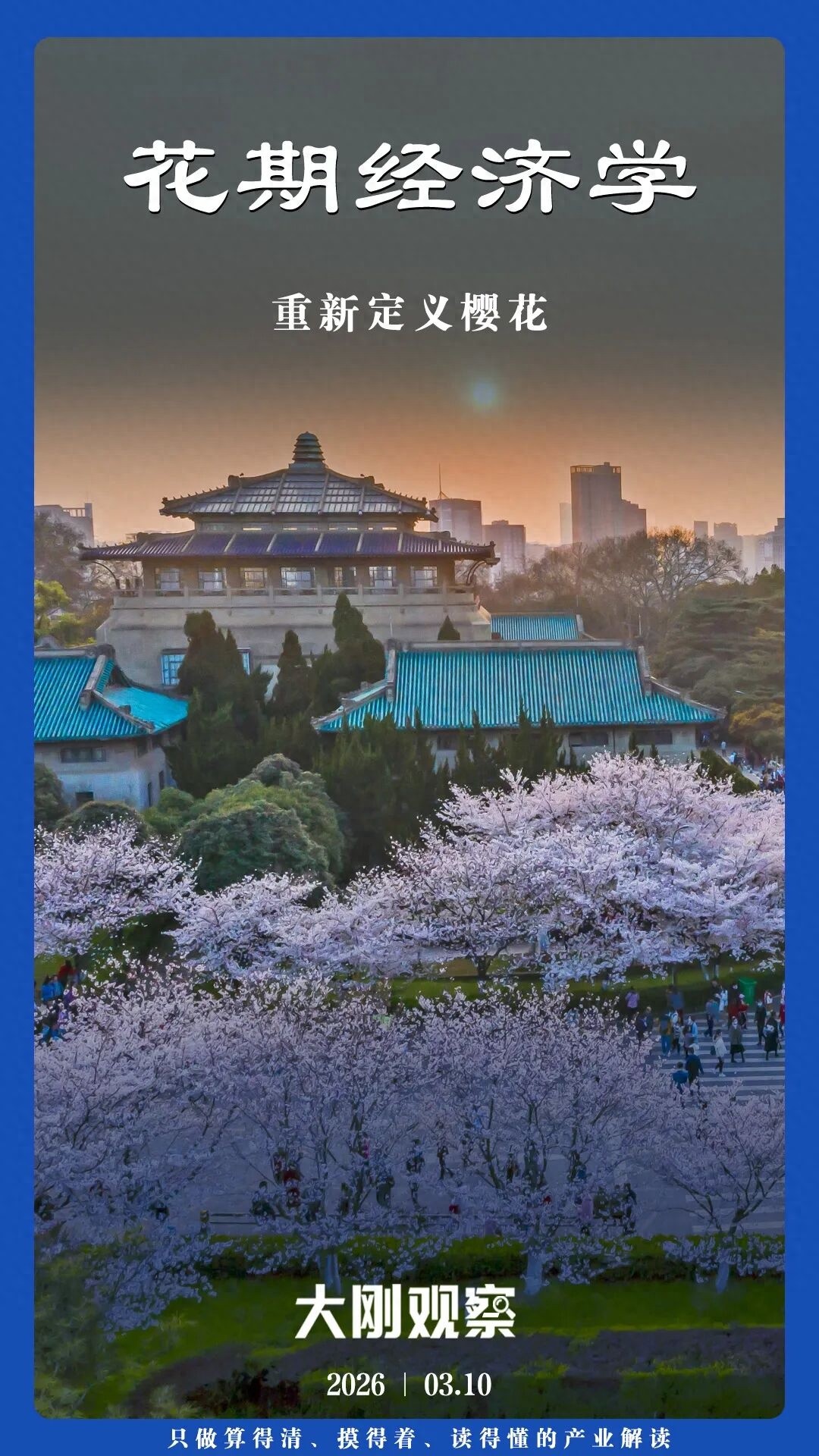
On the flower-viewing circuit, Wuhan, with more than 500,000 cherry blossom trees, has become a top city in spring in recent years.
Just a few days ago, Wuhan officially released the 2026 "Meet in Spring Cherry Blossom Viewing" series of activities, with the theme of "Romantic Wuhan, Flowers Along the Way". Wuhan also proposed to build a "world-class cherry blossom viewing destination" and formulated the "Wuhan City Cherry Blossom Viewing Tour Planning and Construction Plan."
At the same time, many cities such as Shanghai, Wuxi, Guiyang, etc. are eyeing cherry blossoms as a traffic entrance, and do not want to miss out on the "flower viewing economy" cake worth hundreds of billions or even trillions.
The challenge comes not only from other cities but also from time. The flowering period of cherry blossoms is short. How can Wuhan race against time to extend the flowering period, preserve spring, and produce flowers all year round?
A small cherry blossom is not simple. Behind it is the innovation, wisdom and vitality of a city.

It’s spring again. From city parks to rural fields, flowers are blooming one after another and tourists are everywhere.
When flowers become the entrance to traffic, many cities begin to plant flowers, flower beds, gardens, and even seas of flowers, trying to attract more people to check in. Flower viewing is all "rolled" like this, how can a city stand out?
On the track of cherry blossom viewing, Wuhan not only has a place, but has also topped the list of popularity for many years in a row. There is even a grand occasion of "going to a city for a flower". Behind this is Wuhan’s painstaking efforts and fancy arrangements, which bring new surprises to citizens and tourists every spring.
Speaking of cherry blossoms in Wuhan, if your first thought is Luojia Mountain of Wuhan University, you are showing your age. Nowadays, cherry blossoms have already "walked down" Luojia Mountain and bloomed in various corners such as East Lake Cherry Garden, Qingchuan Pavilion, Hankou River Beach, Jiefang Park, Northwest Lake, and Sha Lake. Cherry blossoms are everywhere in the city, and there are good places to enjoy them everywhere.
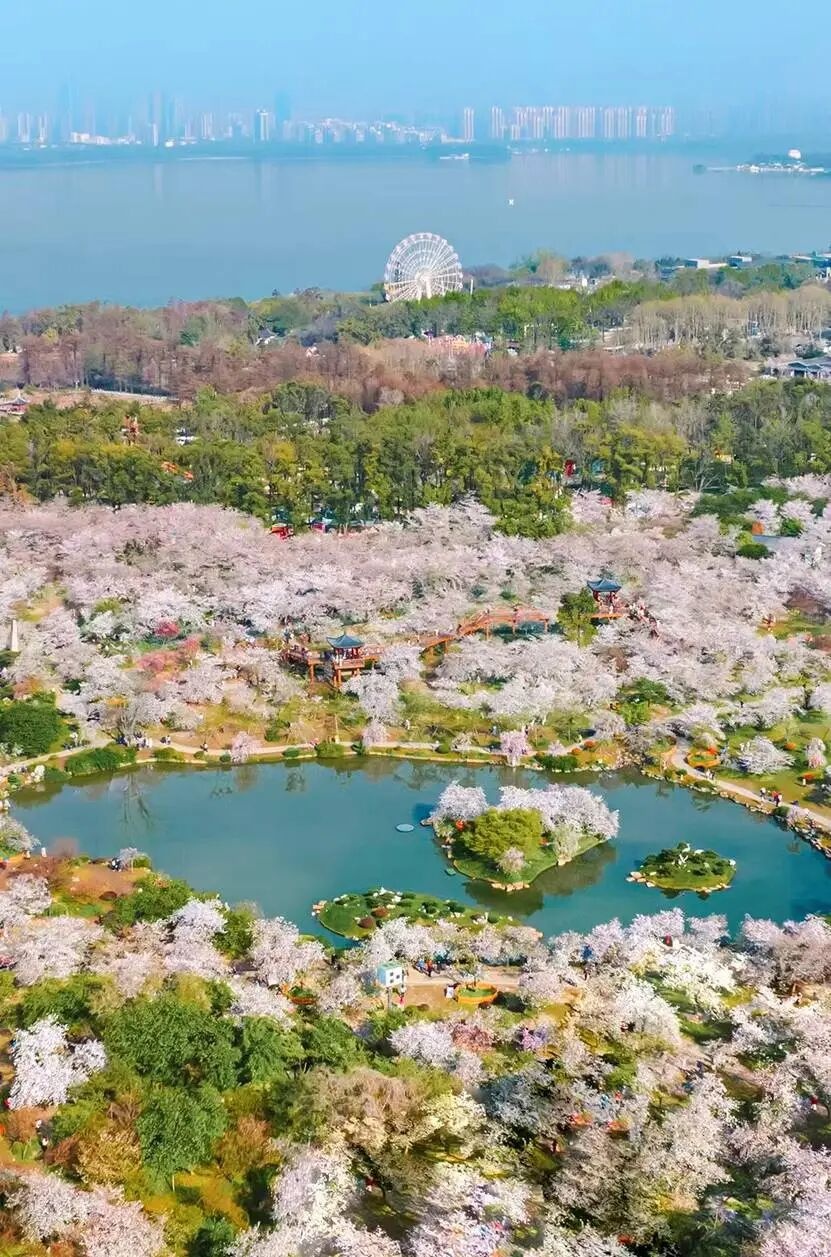
Wuhan breaks away from the traditional must-go scenic spots for cherry blossom viewing and plans to build 45 cherry blossom landscape corridors, including 9 waterside corridors and 36 roadside corridors, breaking the traditional viewing model and creating an immersive and multi-dimensional garden experience.
Not only do cherry blossoms need to be visible everywhere, but the way to enjoy them also needs to be fully realized in 3D. In early March, the East Lake Cruise Ship officially launched the "Cherry Blossom Viewing Cruise Line", allowing people to enjoy the falling cherry blossoms and the perfect color of the water and sky. During the night tour during the cherry blossom season, there are also extra night tours to make it easier to enjoy the night cherry blossoms and the night view of East Lake. You can also go to the sky to enjoy cherry blossoms. Visitors can take the Optics Valley Skyrail to overlook the "Sea of Cherry Blossoms and Clouds", which is mainly three-dimensional, adding a different kind of novelty to cherry blossom viewing.
Although cherry blossoms are beautiful, their flowering period is short, usually only seven days. Wuhan, which "does not accept Zhou", relies on technological innovation to race against time.
On March 9, Hubei Meteorology, together with the Wuhan Municipal Culture and Tourism Bureau and Wuhan Meteorology, officially released the "2026 Wuhan Cherry Blossom Forecast", which accurately calculates the flowering schedule based on comprehensive factors such as temperature, sunshine, and wind speed. This forecast is accurate to the sky and covers popular cherry blossom viewing spots in Wuhan, making it more targeted for cherry blossom viewing.
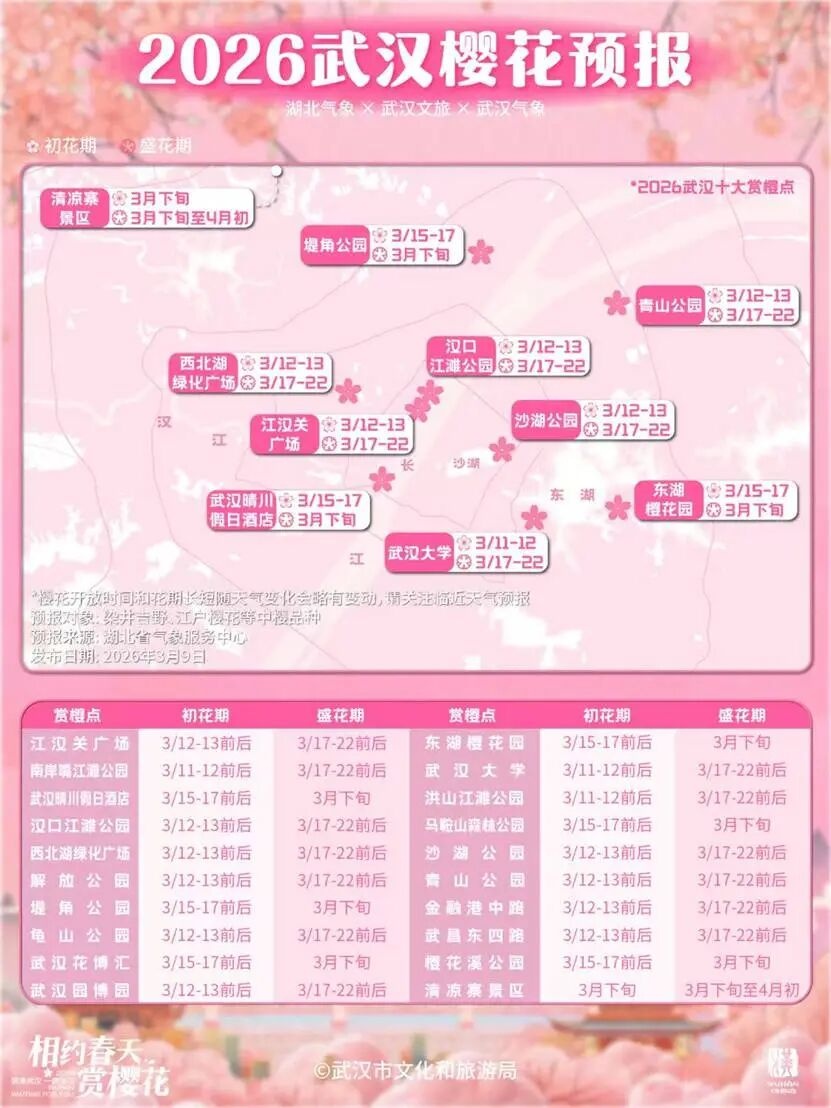
Wuhan also relies on the national cherry blossom germplasm resource bank to extend the cherry blossom viewing cycle through precise variety matching. From the end of February to mid-March, early spring cherry blossoms such as "Chutian Hongri" independently cultivated by the Municipal Landscape Research Institute light up the early spring; in mid-to-late March, mid-day cherry blossoms such as Sunshine Sakura bloom like clouds and snow; in April, late cherry blossoms such as tulip cherry blossoms bloom continuously. Through the scientific planting of early, mid-day and late cherry varieties, the cherry blossom viewing period is extended to nearly two months, achieving "from early spring to late spring, cherry blossoms continue to bloom."
There are more and more choices for cherry blossom viewing, the "eyes" of cherry blossom viewing are getting sharper and sharper, the cherry blossom blooming period is getting longer and longer, and Wuhan's annual "cherry blossom time" is becoming more and more exciting.

Vitality begins with flowers but doesn’t end with them.
The government work report has put expanding domestic demand at the top of the work tasks for two consecutive years, especially "implementing special actions to boost consumption" in a prominent position.
Last year, Wuhan's total retail sales of consumer goods exceeded 900 billion yuan, an increase of about 5%, and it was just one step away from being a city with a trillion-dollar consumption.
Wuhan has clarified its goals in the previously released "Wuhan Three-Year Action Plan to Create an International Consumption Center City (2025-2027)". In 2027, the city's total retail sales of consumer goods will exceed 1.07 trillion yuan, the total number of tourists will increase by an average of more than 8% annually, the number of inbound tourists will increase by an average of more than 30% annually, and the comprehensive tourism revenue will increase by an average of about 10%.
Cherry blossoms are not only the "city card" of Wuhan, but also a breakthrough in expanding domestic demand and boosting consumption. During last year's cherry blossom season, the number of tourists received by East Lake Cherry Garden exceeded one million for the first time, reaching 1.0636 million, of which 77.33% were foreign tourists.
This year’s government work report also proposed that we should create a number of new consumption scenarios with wide coverage and high visibility, and accelerate the cultivation of new growth points for consumption. In addition, the concept of integration of culture, tourism, sports and commerce also officially appeared in the government work report for the first time.
Wuhan's 2026 "Meet to Enjoy Cherry Blossoms in Spring" series of activities integrates resources from all regions to suit the situation and launches a total of 316 activities in five series including cultural tourism, sports, business, investment, and gardens. The cultural tourism section alone has arranged 130 cultural tourism activities such as romantic flower viewing, watching performances and exhibitions, and fashionable entertainment.
Major scenic spots and neighborhoods have launched various "Sakura+" experiences. For the first time, Wuhan held intensive performances during the cherry blossom season, including solo concerts by Nicholas Tse, City of Stars, Tao Zhe, Shan Yichun, Wang Feng, etc., achieving a deep integration of the fan economy and cultural tourism consumption.
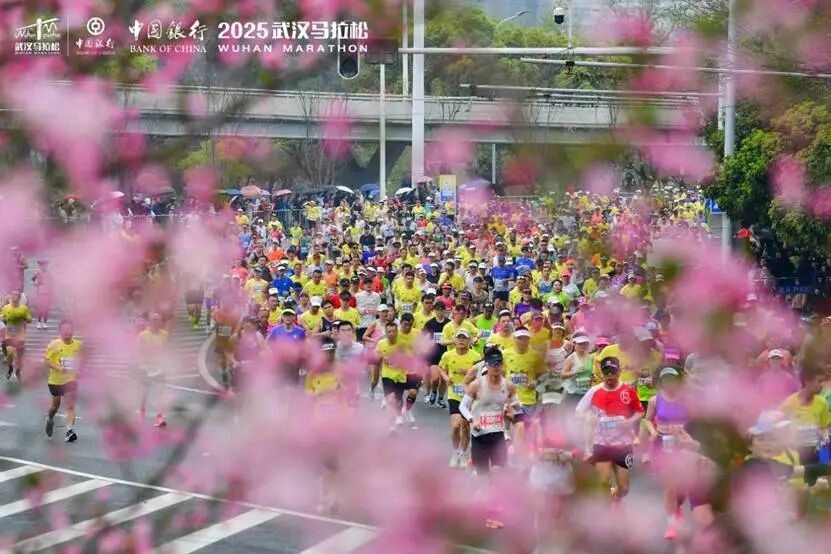
Starting in 2024, the Wuhan Marathon will be deliberately moved to March, the cherry blossom viewing season.
In addition to creating the most beautiful cherry blossom race track, this year we also launched the Han Horse Tourism Season, deeply linked with many core scenic spots such as East Lake Cherry Garden, created a number of "sports + cherry blossom" quality tourism routes, organized "Horse Racing and Cherry Blossom Viewing" themed tour groups, issued 10 million yuan in sports consumption coupons on the "Han Sports" platform, and built special consumption scenes in many old food districts.
It is worth mentioning that cherry blossoms represent more than just consumption. Wuhan is interested in discovering the side of "sakura blossoms" that promotes industrial development.
During this year's cherry blossom viewing season, Wuhan has also planned more than 40 investment promotion activities, the highlight of which is the "Meet the Spring Cherry Blossoms" economic and trade negotiation event, and will focus on planning a series of themed activities focusing on Chucai gathering, grain industry investment, and foreign investment.
Romantic cherry blossoms are both scenery and opportunity.

Behind the cherry blossoms, more systemic renewal is taking place.
The Qingchuan Pavilion Scenic Area, which was closed for repairs and maintenance in November last year, has recently reopened to the public. Set against the backdrop of cherry blossom trees, Qingchuan Pavilion will become a strong contender as a popular cherry blossom viewing spot.
If you zoom out, you will see multiple urban renewal areas throughout the city, providing a better background and stage for cherry blossom viewing. After these areas have been updated, they have provided better tourist carrying capacity and better protection for citizens' lives.
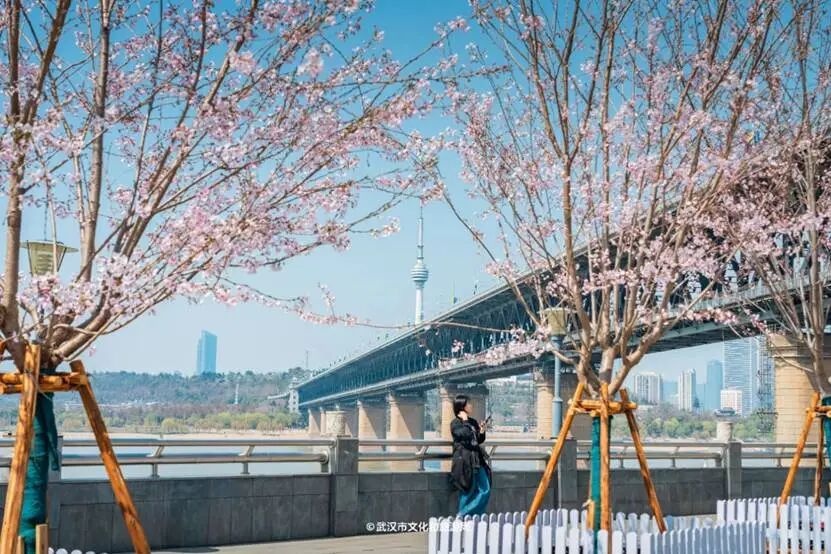
The imagination that flowers bring to the city does not end there.
The "China Flower Viewing Tourism Report 2025" jointly released by the China Tourism Academy and Mafengwo recently selected the top ten flower viewing tourism destinations, and Wuhan was among them. Along with the cherry blossoms of Wuhan East Lake and Wuhan University, there are lotus and plum blossoms of West Lake in Hangzhou.
Plum blossom is the city flower of Wuhan, and there are many places to enjoy plum blossoms in Wuhan. The natural scenery of the City of Hundreds of Lakes has made lotus flowers a daily sight in Wuhan in summer. Wuhan can create a flower-viewing economy for each season throughout the year.
Jiangsu Xinghua has built a closed loop of year-round tourism through the four-season IP of "seeing cauliflowers in spring, lotus flowers in summer, chrysanthemums in autumn, and reed flowers in winter". The time-series landscapes such as forsythia, peach blossoms, and sophora japonica created in Qinglongyu, Jinan, have also achieved "flowers every month and income generation throughout the year."
In the spatial dimension, there is also the possibility of cooperation.
Last year, the "Flowers Blooming in Three Places" series of activities in Beijing, Tianjin and Hebei integrated the resources of Beijing peach blossoms, Tianjin roses and Hebei pear blossoms to build a global flower viewing network, providing a creative and flexible link for the coordinated development of Beijing, Tianjin and Hebei.
This year, “promoting the accelerated development of urban agglomerations in the middle reaches of the Yangtze River” appeared in the government work report for the first time. The coordinated development within the urban agglomeration in the middle reaches of the Yangtze River can use cultural tourism as a driving force for advance cooperation.
On May 20, 2024, the news that "Changsha and Wuhan have officially announced" became a hot search topic. The two cities used lights to show their love, expressed their love on the city's big screens, and jointly sent more than 200,000 gardenias. Nanchang Cultural Tourism immediately responded with "It's Always Quiet": It's obviously a movie about three people, but I can't be named.
It can be seen that not only cherry blossoms, but also gardenias have the potential to be trending. In the future cultural tourism cooperation between the three places, using flowers as a matchmaker can exert greater energy.
In addition to expanding outward, there is also digging inward. Focusing your gaze back on the cherry blossoms in front of you will occasionally make you feel like you are in another world. For a long time, the image of cherry blossoms has almost always been bound to poignant images such as mourning.
But on a spring day in Wuhan, romantic cherry blossoms meet huge crowds of people and human fireworks. Wuhan uses its popularity and vitality to reinterpret the concept and cultural connotation of cherry blossoms.
Cherry blossoms are not exclusive to any one country. Biogeographic research shows that cherry blossoms originate from the foothills of the Himalayas, and China is the hometown of cherry blossoms. Cherry blossoms flourished in the Tang Dynasty. The famous poet Li Shangyin's poem "Cherry Blossoms on the Bank of the Alley with Weeping Poplars" was the first time that cherry blossoms were recorded as a proper noun.
Wuhan’s reinterpretation of cherry blossoms is more like a return. Enjoying it alone is not as good as enjoying it together, which is the true nature of cherry blossom viewing. Just like Bai Juyi said, "There are thousands of cherry blossoms in the coming spring. Who will sit under them in the coming spring?"
This is the people’s city and everyone’s cherry blossom.