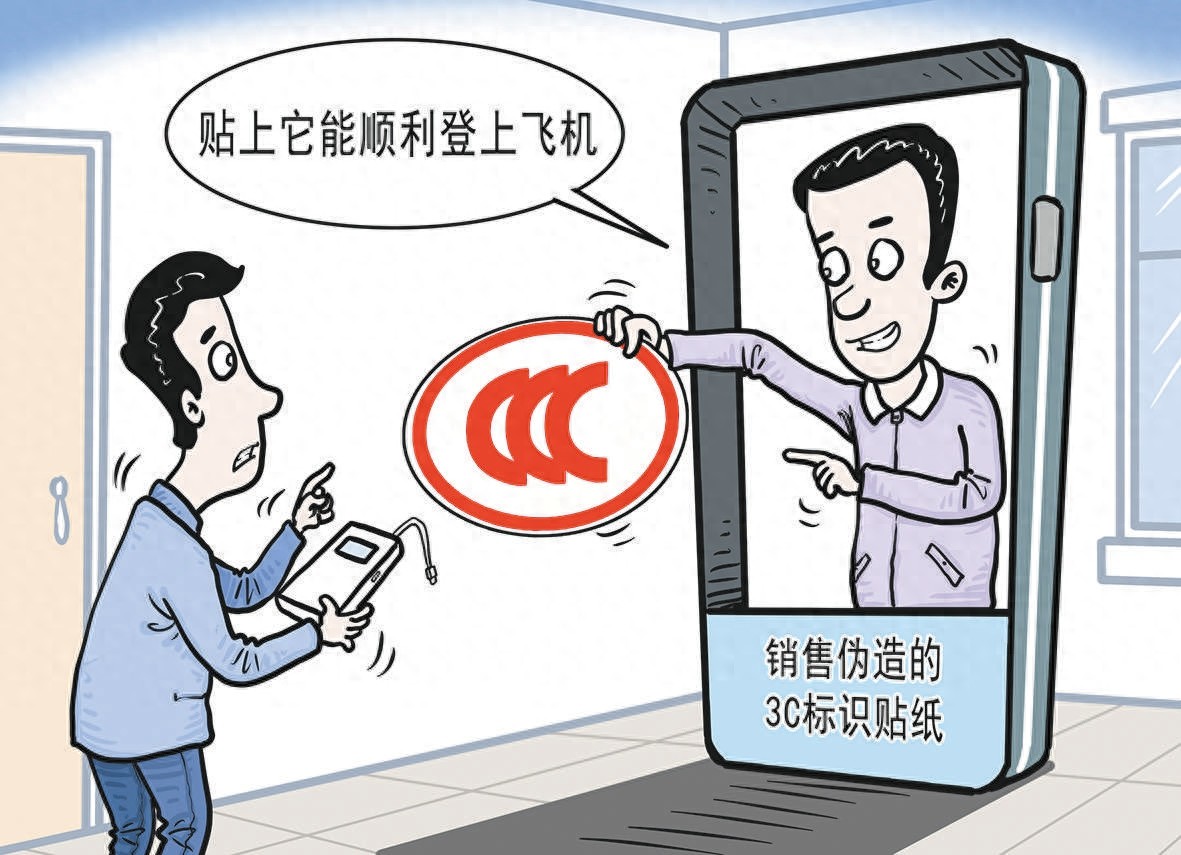
"Passengers are prohibited from carrying power banks that do not have the 3C logo, have unclear 3C logos, or have recalled models or batches on domestic flights." Recently, the Civil Aviation Administration of China's ban has made the issue of 3C certification of power banks a topic of public concern. However, some merchants have since sensed "business opportunities" and openly sell cheap "3C certification stickers" on e-commerce platforms, and even provide "customized year" services, explicitly or implicitly indicating that consumers can use power banks to "pass the labeling and inspection." Although some online platforms have taken actions to strengthen supervision, some merchants still secretly sell related products by secretly changing links and canceling keywords. So, are the manufacturers and sellers of “3C” logo stickers violating the rules? How should online platforms be regulated?
1 The production and sale of “3C” logo stickers is suspected of being illegal
3C certification is "CCC" (China Compulsory Certification), the full name is "China Compulsory Product Certification". This is a compulsory market access system implemented in accordance with the law in my country to protect the personal safety of consumers, national security and the environment. It is not only related to whether the product can legally enter the market, but also reflects the company's compliance with product quality and safety standards. So, what troubles may arise from products without 3C certification?
According to media reports, a certain brand of power bank that a consumer was charging at home suddenly ignited, causing mattresses and other items to burn. The walls and wardrobes in the home were blackened, causing direct economic losses of nearly 3,000 yuan. His family members were slightly burned when handling the fire. The power bank involved belonged to a recall batch that a company had previously announced. The company has contacted the parties involved to negotiate compensation. In recent years, fire accidents caused by explosions of power banks have occurred from time to time, posing great risks to consumers' personal health and social and public safety. In March 2023, the State Administration for Market Regulation issued the "Announcement on the Implementation of Compulsory Product Certification Management for Lithium-Ion Batteries and Other Products", which included mobile power products such as power banks and portable energy storage power supplies into the scope of CCC certification. It was clarified that starting from August 1, 2024, those who have not obtained the CCC certification and the certification mark may not be factory, sold, imported or used in other business activities. 3C certification needs to be obtained after strict evaluation by a designated certification agency. Privately purchasing "3C" logo stickers through online shopping channels is obviously an act of deception. With the recent release of new regulations on power banks by the Civil Aviation Administration of China, some merchants on online shopping platforms have blatantly violated relevant laws and regulations by producing and selling "3C" stickers for their own personal gain, causing risky power bank labels to pass inspection and creating a false sense of safety.
The appearance of "3C" logo stickers involves violations of multiple legal regulations. First of all, the production of "3C" logo stickers by producers is a typical act of forging certification marks. It has crossed the legal red line and will face corresponding legal sanctions. According to Article 70 of the "Regulations of the People's Republic of China on Certification and Accreditation", anyone who forges, fraudulently uses, or buys and sells certification marks or certification certificates shall be investigated and punished in accordance with the Product Quality Law and other legal provisions. Article 31 of my country's Product Quality Law stipulates that producers shall not forge or falsely use quality marks such as certification marks; Article 53 stipulates that anyone who forges or falsely uses quality marks such as certification marks shall be ordered to make corrections, the illegally produced and sold products shall be confiscated, and a fine equal to the value of the illegally produced and sold products shall be imposed; if there are any illegal gains, the illegal gains shall also be confiscated; if the circumstances are serious, the business license shall be revoked.
Secondly, the seller is the direct party that provides products to consumers and is one of the subjects of the contractual liability relationship. As an intermediary to promote products, the seller has obligations and responsibilities prescribed by law. The behavior of sellers selling "3C" logo stickers has seriously disrupted the normal commodity certification and market circulation order. Article 38 of the Product Quality Law stipulates that sellers shall not forge or falsely use quality marks such as certification marks. Violators of this provision will face penalties such as fines, confiscation of illegal products, confiscation of illegal income, and revocation of business licenses.
In addition, if a consumer has a safety accident due to the use of a power bank with a fake "3C" logo sticker, according to the relevant provisions of the Civil Code, the infringed party may demand compensation from the manufacturer or seller. It can be seen that whether it is producing or selling "3C" logo stickers, it is an illegal act and will be subject to corresponding penalties and responsibilities.
Judge reminds
Producers are the direct manufacturers of products and are the "first step" in controlling product quality. They should use product quality marks correctly to ensure that product quality matches the quality marks and should not be opportunistic. The illegal production of quality marks violates national prohibitive norms and is an illegal act and will be punished accordingly.
Sellers are the link between product producers and consumers and the bridge for product circulation. Sellers and consumers establish a buying and selling relationship based on equality, good faith, and equal value for money. Consumers have the right to obtain products of qualified quality, and sellers have the obligation to provide consumers with qualified products. Sellers should seek truth from facts, proceed from the interests of consumers, ensure the quality of the products sold, perform their obligations in a good faith and reasonable manner, and must not conceal the truth or deceive consumers with shoddy goods.
2 Platforms that fail to supervise their businesses will face fines for business suspension
After the Civil Aviation Administration of China's new power bank regulations were announced, some media investigations found that a large number of links popped up after searching for keywords such as "3C mark" on multiple online platforms, and some merchants even specially set up relevant sales packages. Through these links, you can buy thousands of "3C stickers" for a few yuan, and customized "3C seals" for less than a hundred yuan.
As general operators, platform operators should perform various obligations of general operators in accordance with the provisions of laws and regulations. For the sales and trading of "3C" logo stickers, the e-commerce platform cannot escape the blame. It "turns a blind eye" to the sales behavior, opens the door for "3C" logo stickers, indulges in the listing and trading of illegal products, violates legal provisions, and will face corresponding penalties.
First of all, platform operators bear the responsibility of subject review and should review the qualification information of operators settled in, products sold, and services provided. According to Article 12 of my country's E-commerce Law, e-commerce operators who engage in business activities and need to obtain relevant administrative licenses shall obtain administrative licenses in accordance with the law; Article 13 stipulates that the goods sold or the services provided by e-commerce operators shall comply with the requirements for ensuring personal and property safety and environmental protection requirements, and shall not sell or provide goods or services that are prohibited from trading by laws and administrative regulations. All products within the scope of 3C certification must obtain certification before entering the market. Operators selling "3C" logo stickers on e-commerce platforms have obviously not obtained administrative permission and do not have the corresponding identity and qualifications. They are selling products prohibited by law and violate the relevant provisions of the e-commerce law. When operators discover that the goods or service information on the e-commerce platform contains the above illegal acts, they shall take necessary disposal measures in accordance with the law, promptly prevent merchants from illegal sales activities, eliminate potential safety risks, and report to the relevant competent authorities.
Secondly, platform operators bear the responsibility for collaborative supervision. As the provider of trading venues, they have the obligation to supervise the order of platform transactions and the quality and safety of commodities. For a long time, e-commerce platforms have mainly implemented supervision by setting up blocked words, consumer reviews, complaints and reports, etc. However, the above supervision methods may be lagging behind, or may not be effective for "vest"-style sales. There are still merchants who use more covert methods to secretly sell products, which cannot fundamentally prevent illegal products from being put on the shelves. This year, the State Administration for Market Regulation promulgated the "Measures for the Supervision and Administration of Online Transactions" to further expand the scope of regulatory responsibilities of online platform operators and require online trading platform operators to establish an inspection and monitoring system for operators on the platform and the goods or service information they publish, that is, to shift from "formal review" to "substantive review." If an online trading platform operator discovers that the goods or service information on the platform violates market supervision laws, regulations, and rules, harms national interests and social public interests, and violates public order and good customs, it shall take necessary disposal measures in accordance with the law, keep relevant records, and report to the market supervision and management department at or above the county level where the platform is domiciled.
Finally, platform operators who fail to fulfill their obligations will face penalties. According to the provisions of Article 80 of the E-Commerce Law, if an e-commerce platform operator fails to verify merchant qualifications, fails to perform its obligation to deal with illegal activities, or fails to perform its reporting obligations, it may be ordered by the relevant competent authorities to make corrections within a time limit; if it fails to make corrections within the time limit, it will be fined not less than 20,000 yuan but not more than 100,000 yuan; if the circumstances are serious, it will be ordered to suspend business for rectification and fined not less than 100,000 yuan but not more than 500,000 yuan.
Judge reminds
Online shopping has gradually become the first choice for consumers. E-commerce platform operators have gained benefits from platform commercial activities and should assume certain social responsibilities and obligations. E-commerce platform operators have massive data resources and advanced technological advantages, and in fact have the ability to audit and supervise. They should do their best to audit the qualifications of platform operators, improve supervision capabilities and supervision efficiency, increase the intensity of audits and penalties for the sale of similar illegal goods, remove risky goods in a timely manner, and make the online trading platform clear through a combination of legal means, technical means and industry self-discipline. Market supervision departments should further refine and sort out the legal responsibilities and obligations that platform operators should bear on the basis of existing laws and regulations, strengthen administrative guidance for platform operators, promote platform self-discipline through other laws, and maintain the bottom line of safety.
3. The "3C" mark constitutes counterfeit use if it is purchased on non-commodities.
In the digital age, power bank is almost a must-have for everyone. As soon as the new regulations on power banks came out, some consumers found that although the well-known brand power banks they were using had good performance, they were missing the key "3C" logo and could not meet the boarding needs. They could not bear to throw away the unmarked power banks, so they thought of buying "3C" logo stickers, with the intention of allowing them to evade supervision and board the plane in disguise. However, these consumers are smart and ignore public safety for petty profits. The behavior of purchasing "3C" logo stickers and affixing them to uncertified products not only constitutes a typical act of fraudulent use of certification marks, but also poses hidden dangers to their own health and public safety. They also face the risk of corresponding legal liability.
According to media reports, a passenger learned at the airport that his power bank did not comply with relevant regulations and could not be carried on the plane. In anger, he threw the power bank to the floor, causing the power bank to spontaneously ignite and smoke rising from the scene. The public security agency subsequently imposed a ten-day administrative detention penalty on the passenger. It can be seen that taking a power bank that spontaneously ignites as soon as it is dropped on a plane will have serious consequences if you are not careful. According to the relevant provisions of the currently effective "Public Security Administration Punishment Law of the People's Republic of China", those who disrupt the order of stations, ports, docks, airports, shopping malls, parks, exhibition halls or other public places will be given a warning or a fine of not more than 200 yuan; if the circumstances are serious, they will be detained for not less than five days but not more than ten days, and may be fined not more than 500 yuan. If consumers intentionally purchase "3C" logo stickers and use fake certifications to pass security inspections, their behavior is suspected of disrupting public order and may face administrative penalties; if they cause personal injury or property damage to others, according to the provisions of the Civil Code, the infringer shall bear corresponding civil liability and compensate the infringed party for corresponding economic losses.
Judge reminds
The "3C" certification mark is not a commodity and cannot be circulated in the market. Marks containing the word "CCC" sold online are illegal and consumers cannot purchase them. When purchasing power bank products, consumers should purchase from formal channels such as offline counters and online flagship stores, and look for the "3C" logo. If necessary, they can log in to the "National Certification and Accreditation Information Public Service Platform" and enter the "3C" certificate number of the power bank for verification. At the same time, you must learn to use power bank correctly in daily life to avoid "power bank" becoming "charging explosion".