The third is to build a robot training ground. It is not difficult to build robots now, but the difficulty lies in the intelligent body. The housekeeping scene is like the "tenth month pregnancy" of AI. Real household data is used to train the intelligent agent and make the robot truly "alive". To put it simply, AI serves as a knowledge base for waiters and a brain for robots. Without AI, it would be impossible for housekeeping to develop with high quality.
Geng Funeng, deputy to the National People's Congress and chairman of Good Doctor Pharmaceutical Group, focuses on primary care, a "key area" for people's livelihood. In 2025, he put forward the suggestion of "AI assisting hierarchical diagnosis and treatment." This year, he continued to make suggestions and called for equipping grassroots doctors with AI "assistants."
"Primary medical institutions include community health service centers, township health centers, village clinics, clinics and other types. They are the first line of defense to protect people's health. They are also a key carrier for implementing the hierarchical diagnosis and treatment system and easing the pressure on large hospitals."
Geng Funeng noticed that in reality, medical AI capital and technical resources are more concentrated in tertiary hospitals. Grassroots institutions have limited funds and weak procurement and operation and maintenance capabilities. Grassroots doctors still treat patients with the same three things – stethoscopes, thermometers and sphygmomanometers, which are no longer able to meet the needs of the masses.
In this regard, he believes that the advantages of AI should be used to help grassroots doctors make efficient and accurate diagnoses. He suggested setting up a special subsidy for the application of AI robots for grassroots doctors, with the central and local finances sharing it in proportion. For the purchase of AI agents that meet the management needs of common and chronic diseases at the grassroots level, a 30%-50% purchase subsidy will be provided, with an appropriate increase in rural areas, and an annual operation and maintenance subsidy will be provided.
At the same time, admission standards and recommended catalogs for primary medical AI agents were formulated to clarify the role of AI. It is a tool that grassroots doctors need to master and is an "assistant" rather than a "replacement" for diagnosis and treatment. During use, grassroots doctors need to clarify the boundaries of technology-assisted diagnosis and treatment and improve their ability to judge and monitor AI results.
In addition, Geng Funeng believes that the combination of AI and the concept of “preventing disease” in traditional Chinese medicine can be promoted. Connect data from three scenarios: homes, clinics, and hospitals to build large models to carry out disease prediction and prevention, allowing people to achieve independent health management through AI just like using household appliances.
As my country's aging population continues to deepen, elderly care services have also become a key livelihood issue of concern during the two sessions, and the relevant suggestions for AI-enabled elderly care have aroused widespread resonance.
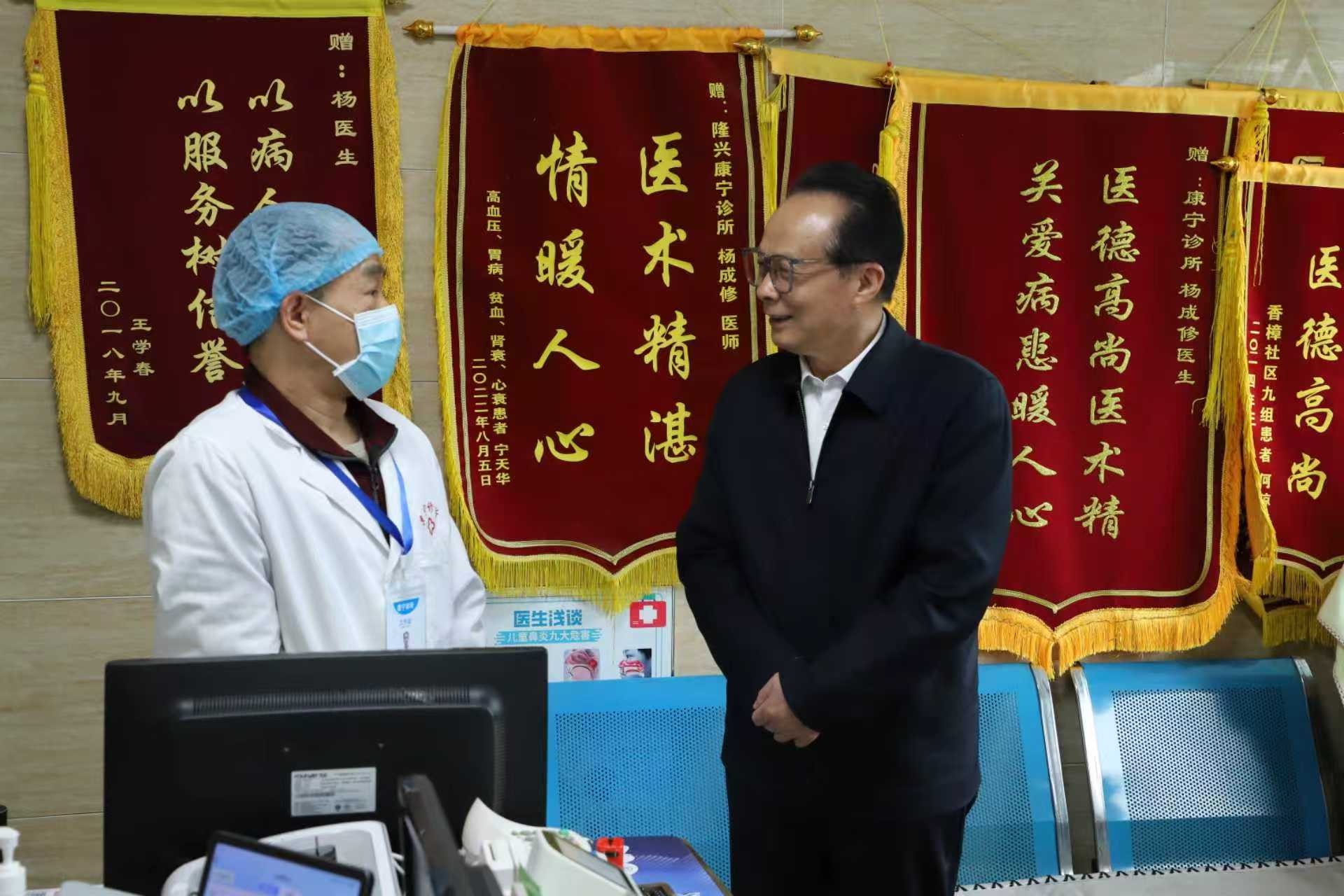
Geng Funeng is investigating the application of artificial intelligence in grassroots clinics in Chongzhou City. Picture/provided by interviewee
【2】Accelerate the introduction of the "National Elderly Care Robot Industry Development Action Plan"
According to China News Service, Ge Minghua, a representative of the National People's Congress and president of Zhejiang Provincial People's Hospital, said that the current gap in our country's elderly care nursing staff is about 5.5 million people. In his view, accelerating the development of the elderly care robot industry is the key to solving the contradiction between supply and demand of elderly care services in the era of population aging.
As an important carrier of "AI + elderly care", elderly care robots can cover three major scenarios: home, community, and institution, and provide multiple services such as care, companionship, and health management. It is judged to be a trillion-level blue ocean track that is expected to rival the automobile industry. However, Ge Minghua's research found that China's elderly care robot industry is still in its infancy and cultivation stage, and there is an urgent need to remove development obstacles in terms of systems, technology, and markets.
The lack of top-level design is the primary problem. He admitted frankly that a special development plan for elderly care robots has not yet been issued at the national level, policies are scattered in various comprehensive documents, and the cross-departmental coordination mechanism is not smooth. Subsidy funds for the construction of the elderly care service system do not include a separate budget for the purchase of elderly care robots. Supporting policies such as the first unit (set) application and large-scale procurement are missing, and there is insufficient motivation for industrialization.
The lag in technical research is also prominent. In aspects such as complex environment perception and human-computer collaborative interaction, domestic technology still lags behind international standards. Core components are highly dependent on imports. In addition, the "research, production and use" collaborative system is missing, there is a lack of leading enterprises to lead, and the industrial agglomeration effect has not yet been formed.
The low matching between supply and demand has become another bottleneck. Ge Minghua pointed out that the current supply of large-scale application scenarios for elderly care robots is insufficient, and most products remain in the laboratory stage. The product's aging suitability is low and its operation is complicated. More than 60% of the elderly have concerns about product operation and safety. The payment security system is imperfect, and long-term care insurance and medical insurance provide limited support for equipment purchase and leasing.
In this regard, Ge Minghua suggested strengthening top-level design, accelerating the introduction of the National Action Plan for the Development of the Elderly Care Robot Industry, establishing a cross-department coordination mechanism, and coordinating and solving issues such as product access and standard formulation; establishing a national-level elderly care robot industry guidance fund, including elderly care robots within the scope of the first (set) policy, and providing fixed subsidies for the purchase of compliant products.
"In terms of tackling core technologies, it is recommended to organize and implement core technology research projects, focusing on the collaborative optimization of humanoid robots and the localization of core components to carry out joint research. We can also build cross-ontology open source data sets and full-chain data platforms to further promote the construction of interdisciplinary universities in universities and directional training of interdisciplinary talents." Ge Minghua said.
It recommended further expanding application scenarios, creating a national-level application demonstration scenario, and deploying it through the model of "the government subsidizes a little, enterprises give a little, and insurance guarantees a little", and explore the inclusion of compliant intelligent care equipment in the payment scope of medical insurance and long-term care insurance, establish aging-appropriate design standards and product certification mechanisms, and encourage companies to provide one-stop services of "installation-training-maintenance".
"The elderly care robot industry is not only a strategic need to cope with the aging of the population, but also an important starting point to cultivate new growth points for the silver economy." Ge Minghua said, hoping to speed up the removal of development obstacles and allow more elderly people to enjoy high-quality elderly care services brought by technological innovation.
Jiupai News special correspondent Gong Lingwei and Hu Bingyue reported from Beijing
Editor Wu Diwu Feifei