The U.S. military suddenly canceled its elite troop exercises, further triggering speculation about its troop deployment in the Middle East.
On the 6th local time, the U.S. "Washington Post" quoted multiple officials as saying that the U.S. Army recently suddenly suspended the major exercises originally planned to be held by the 82nd Airborne Division at Fort Polk, Louisiana, and ordered it to stay at the Fort Bragg base in North Carolina on standby.
According to reports, a brigade-level combat team of about 4,000 to 5,000 people under the 82nd Airborne Division can complete deployment within 18 hours after receiving an order, and undertake diverse tasks such as seizing key facilities such as airports, strengthening embassy security, and performing emergency evacuations.
The report pointed out that although no official deployment order had been issued as of Friday, this unusual move has triggered speculation within the Ministry of Defense: As the conflict between the United States and Iran continues to escalate, this elite paratrooper unit, which is good at ground combat and various tasks, is likely to be transferred to the Middle East.
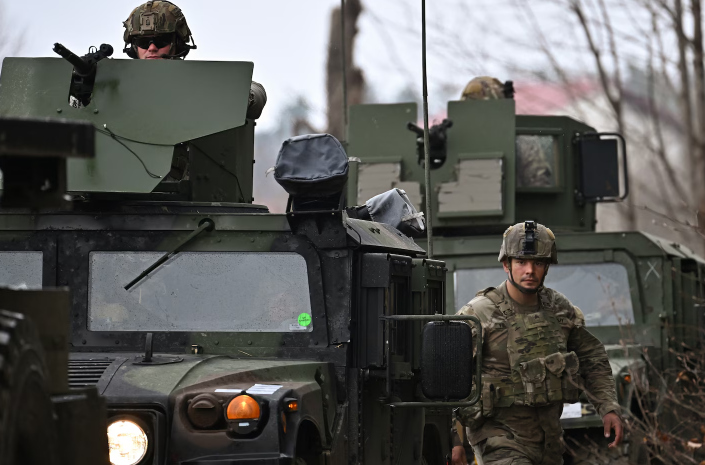
In 2022, soldiers of the U.S. 82nd Airborne Division were in Wola Kozhenzka, Poland. "Washington Post"
Given that the 82nd Airborne Division has played a key role in all crises and is the core of the U.S. Army's global rapid response force, it is generally believed that it is likely to be recruited first.
In recent years, the 82nd Airborne Division has been ordered to strengthen the security of the U.S. Embassy in Baghdad many times, especially before the U.S. assassination of Qasem Soleimani, the commander of the Iranian Islamic Revolutionary Guard Corps' Quds Force, in 2020. In addition, it will play a central role in the withdrawal from Afghanistan in 2021 and the deterrence deployment of US troops in Eastern Europe before the outbreak of the Russia-Ukraine conflict in 2022.
Multiple anonymous U.S. officials revealed that the Army is expected to announce in the near future that helicopter units attached to the 82nd Airborne Division will deploy to the Middle East as previously planned, but related operations will not begin until later in the spring.
"We are all preparing for some kind of situation – just in case," said an official familiar with the matter.
When asked about the matter, the Pentagon issued only a brief statement and refused to disclose details. "For security reasons, we do not discuss future or hypothetical operations." The U.S. Central Command, which is responsible for operations in the Middle East, declined to comment.
“Iran’s Khark Island may be the US military’s primary target”
According to the "Washington Post" report, nearly a week since the conflict broke out, the US military has mainly relied on air strikes and maritime strikes to continue to destroy Iranian military facilities, missile and drone arsenals, and naval vessels. As Iran's defense system gradually disintegrates, US warplanes and bombers have begun flying directly through Iranian airspace to conduct bombings.
Although Trump has publicly stated that there is a "high probability" that U.S. ground forces will not need to intervene in the current operation, he and his senior staff have always refused to rule out this option.
On the 6th, the Wall Street Journal, NBC and other media quoted sources as saying that Trump had discussed the idea of deploying ground troops to Iran with aides and Republican officials and had shown strong interest in it. Rather than a large-scale ground invasion, the approach favors sending small forces to carry out specific strategic objectives. The source also emphasized that Trump has not yet made a decision or issued an order on this matter.
White House Press Secretary Levitt responded that day that the above-mentioned source was not a member of the White House national security team.
On Wednesday, she also said that sending ground troops to Iran was "not a current plan, but it would not rule out any options on the president's desk."
At a Pentagon briefing on the same day, Chairman of the Joint Chiefs of Staff Dan Kaine declined to comment when asked about the involvement of ground forces, saying only that "this is a question for policymakers."
"I don't make policy," Kaine added, "I implement policy."
He was joined by Defense Secretary Hegseth, who earlier this week refused to rule out the possibility of sending ground combat troops.
Despite the ambiguous attitude of the United States, speculation that "Trump may deploy ground troops to Iran" has continued to heat up on the American Internet. Many American netizens shared that they have military friends who have experienced deployment adjustments in the Middle East.

Others bluntly said: "As far as Trump's intentions are concerned, one division is far from enough. The 82nd Airborne Division is likely to become the first large-scale deployment of troops in theaters."

According to the latest report from NBC, a Department of Defense official revealed that as the war against Iraq advances, the United States plans to recruit more National Guard and Army Reserve personnel to support operations.
Currently, approximately 22,000 Army and Air National Guard members are deployed overseas to perform missions around the world. The official also said that relevant troops had been recruited before the launch of the operation in Iraq, and members of the local guard who had been deployed were also assigned to provide support for the operation from the area where they were located.
A considerable proportion of the personnel and equipment deployed by the US military around the world come from the National Guard and Reserves. The six U.S. military personnel killed in this round of conflicts were all members of the Army Reserve Support Force from Iowa.
The Washington Post quoted analysts as saying that if the United States dispatches ground troops, Iran's Khark Island may become the primary target. The island, located in the Persian Gulf, about 15 miles from the Iranian mainland, is home to Iran's most important oil infrastructure, with about 90% of the country's oil exports transshipped through this facility.
The report pointed out that seizing the island will not only control Iran's core economic resources, but also fit in with Trump's previous strategy of controlling the oil wealth of hostile countries, but it will also expose the US military stationed there to the risk of direct attack.
Michael Rubin, a senior fellow at the American Enterprise Institute, a conservative think tank, believes that seizing Khark Island is "a no-brainer." He also mentioned that the Trump administration seemed to be "increasingly realizing that the Iran problem was much more difficult than they initially thought."