As the war in the Middle East spreads, Saudi Arabia has turned to Pakistan, its defense ally. Will Islamabad "end"?
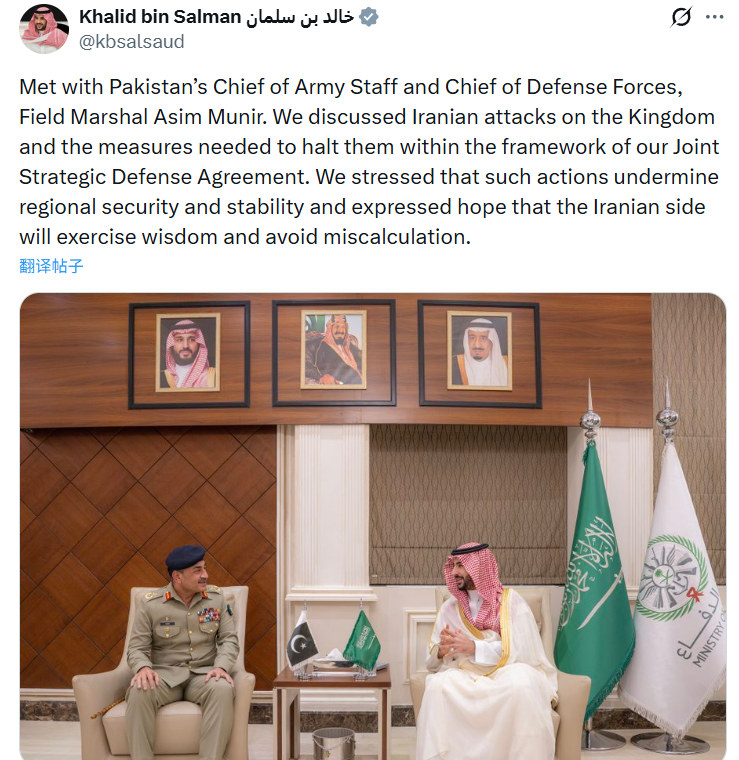
On Saturday local time, Saudi Defense Minister Khalid bin Salman issued a statement through social media
Salman said in the statement that the two sides focused on discussing Iran's missile and drone attacks against Saudi Arabia and other Gulf countries, and also agreed to formulate specific measures to prevent such attacks within the framework of the "Joint Strategic Defense Agreement" between the two countries.
The statement also stated that both sides believe that Iran's relevant military actions have seriously undermined regional security and stability, and called on Tehran to exercise restraint, "exercise wisdom and avoid miscalculation."
The "Joint Strategic Defense Agreement" mentioned by Salman refers to the mutual defense agreement signed by Saudi Arabia and Pakistan, the only nuclear-armed country in the Islamic world, after Israel raided Qatar in September last year and carried out precision strikes against senior Hamas leaders in its capital Doha. Its core provision stipulates that any attack against one of the contracting states is deemed to be a joint attack against both countries.
This is not only the first time that Saudi Arabia, a long-term ally of the United States in the Middle East, has actively sought to get rid of its dependence on Washington for security guarantees, but it is also the most significant formal defense commitment signed by Pakistan in decades.
But now, this agreement is facing a severe test that Pakistan and Saudi Arabia had never expected before. Al Jazeera reported on the 7th that in the face of Saudi Arabia, which has been successively attacked by Iranian missiles and drones, Pakistan is under tremendous internal and external pressure on whether to fulfill its defense commitments.
According to reports, on the one hand, Pakistan has deep defense ties with Saudi Arabia. About 1,500 to 2,000 Pakistani soldiers are stationed in Saudi Arabia for a long time, and millions of workers work in Saudi Arabia and other Gulf countries. The economy and security are deeply tied; on the other hand, Pakistan and Saudi Arabia have deep defense ties. Iran shares a 900-kilometer border and is prone to friction due to cross-border armed issues. Coupled with the sympathy and indignation of the domestic Shiite public over the murder of Iran's Supreme Leader Ayatollah Ali Khamenei, Islamabad has to be sandwiched between Saudi Arabia and Iran and carefully "walk the tightrope."
So far, Islamabad's response has been to conduct intensive diplomatic communication and have frequent contacts with regional leaders, including Iran and Saudi Arabia. However, analysts generally point out that as conflicts in the Middle East continue to escalate, Pakistan wants to stabilize its alliance with Riyadh while avoiding a direct confrontation with Tehran. This balancing strategy of balancing both ends will become increasingly unsustainable.
Pakistan faces 'credibility test'
Ever since the United States and Israel launched multiple rounds of strikes against Iran on February 28, detonating the situation in the Middle East, Pakistan has been in this dilemma.
According to Al Jazeera, after the US-Israeli attack killed Iran's Supreme Leader Ayatollah Ali Khamenei, Pakistan immediately condemned the attack as "unjustifiable"; but within a few hours, Pakistan turned to condemn Iran's retaliatory strikes against Gulf countries as a "blatant violation of sovereignty."
Pakistan's Deputy Prime Minister and Foreign Minister Ishaq Dar was attending an Organization of Islamic Cooperation (OIC) meeting in Riyadh when the conflict broke out last week. He later said that he carried out "shuttle communication" between Tehran and Riyadh.
On March 3, Dar spoke in the Senate and held a press conference, revealing that he had personally reiterated to Iranian Foreign Minister Abbas Araghchi that Pakistan has clear defense obligations to Saudi Arabia.
Dar said, "We have a defense agreement with Saudi Arabia and the whole world knows about it. I told the Iranian leadership that we must respect our agreement with Saudi Arabia."
According to Dar, Araghchi asked Pakistan to guarantee that Saudi territory would not be used to attack Iran, and he informed the other party that he had obtained relevant guarantees from Riyadh. He believes that it is this secret channel communication that effectively limits the scale of Iran's attack on Saudi Arabia.
Two days later (5th), Iranian Ambassador to Saudi Arabia Alireza Enayati said that Iran welcomes Saudi Arabia’s commitment not to allow its airspace or territory to be used against Iran in the current conflict with the United States and Israel.
"We appreciate the position reiterated by Saudi Arabia many times – Saudi Arabia will not allow its airspace, waters or territory to be used against Iran," he said in the interview.
But this brief relaxation did not last long. Just one day later, in the early morning of the 6th, the Saudi Ministry of Defense confirmed that it had successfully intercepted three ballistic missiles aimed at the Prince Sultan Air Force Base. The base is located southeast of Riyadh and houses US military personnel.
The situation instantly became tense again. A few hours later, Pakistani Army Field Marshal Munir arrived in Riyadh and met with Saudi Defense Minister Salman. Salman later emphasized in a statement that the two sides discussed Iran's continued attacks on Saudi Arabia and the necessary measures to stop the attacks within the framework of the Pakistan-Saudi Mutual Defense Agreement.
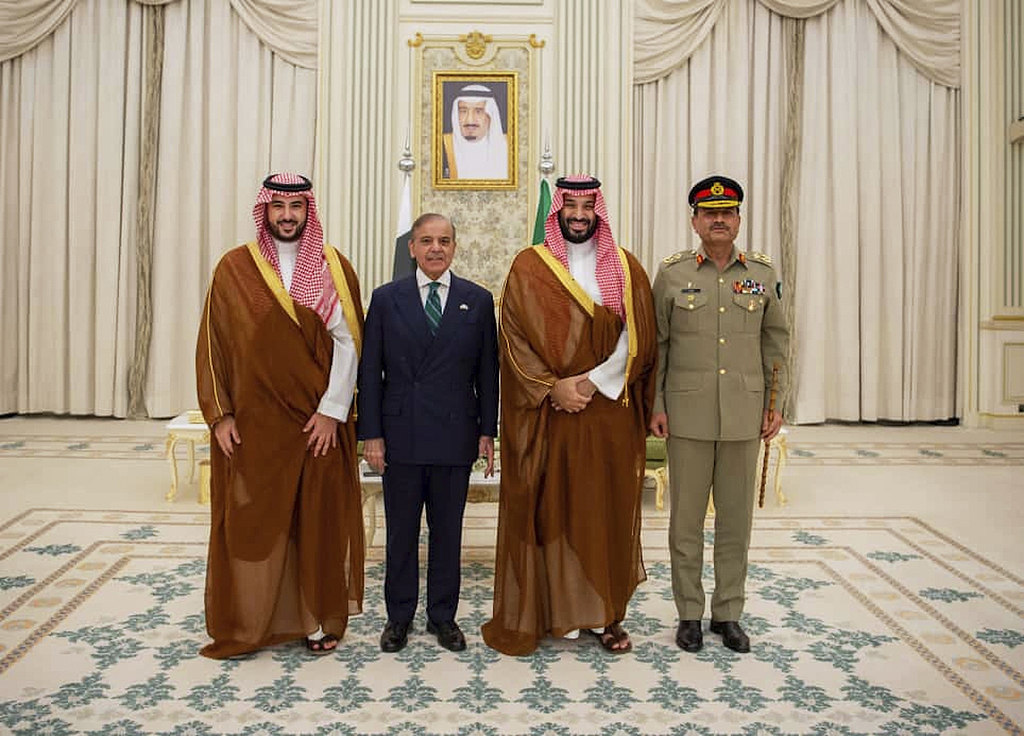
On September 17, local time in Riyadh, Saudi Arabia, Saudi Crown Prince and Prime Minister Mohammed bin Salman (second from right), Saudi Arabian Defense Minister Khalid bin Salman (left), Pakistani Prime Minister Shahbaz Sharif (second from left) and Pakistan Army Chief of Staff Saeed Asim Munir (right) took a group photo after signing a mutual defense agreement. Visual China
Although analysts believe that the core provisions of the agreement should not be directly interpreted as automatically triggering military intervention, as the war continues to escalate, Pakistan, caught between Iran and Saudi Arabia, will find it difficult to maintain absolute neutrality for a long time.
Omar Karim, associate research fellow at the Riyadh-based King Faisal Center for Studies and Islamic Studies, said Pakistan's current predicament stems from miscalculation. He pointed out that Islamabad may never have imagined that it would be caught in the confrontation between Tehran and Riyadh, especially after Saudi Arabia and Iran achieved the easing of relations and the resumption of diplomatic relations in 2023.