Research | Written by Wang Yugang and Lu Shiyu | Zhang Yang
In recent years, quantitative investment has attracted more and more attention, and financial practitioners and institutions have tried to lift the mystery of quantitative investment and obtain higher returns through it. At the same time, with the support of AI, quantitative investment is more efficient. However, for individuals, there are currently only a handful of AI quantitative platforms; for institutions, building an AI quantitative platform has high technical requirements.
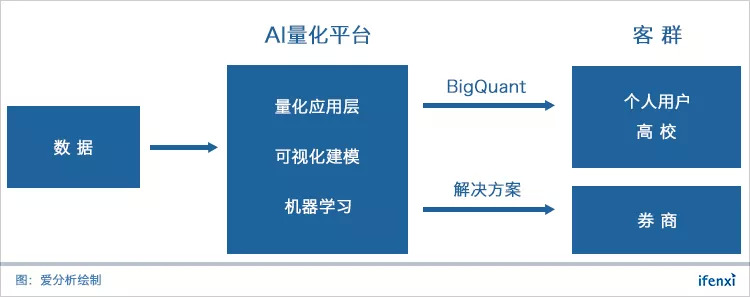
Founded in 2016, Kuanbang Technology applies its own AI technology to quantitative investment, exports a simple and easy-to-use quantitative platform to C-side customers, and provides overall solutions to B-side customers, allowing customers to overcome technical difficulties and directly use AI quantitative tools.
Strategically, Kuanbang Technology first launched the AI quantitative application platform BigQuant for C-end users. In the process, it improved its technical capabilities, optimized its products, demonstrated its strength through the C-end platform, and cultivated brand awareness.
After that, we will provide overall solutions for the AI quantification platform for B-side financial institutions, especially securities firms. At the same time, Kuanbang Technology has commercialized BigQuant’s underlying technology platform and launched the Big AI full-stack artificial intelligence platform, which is commonly used in the financial industry.
For C-side users, the BigQuant website not only has efficient strategy writing functions, but also has a very low technical threshold.
The platform data is mainly public financial market data, and users can also define their own data sources. In terms of technology, users understand the basic principles of AI and quantification, and if they understand a little bit of code, they can write their own strategies on the platform. Through the simulated real trading function, users can easily conduct model backtesting and optimization. Moreover, through authorization, C-side customers can connect their trading strategies to the brokerage platform where they have opened an account and conduct real trading. In addition, platform users can exchange methods, share function tools, and sell their own strategies.
For B-side customers, after Kuanbang Technology has deployed the AI quantification platform, they can directly apply its writing strategies at work, conduct transactions, and pursue high returns.
Kuanbang Technology will provide overall solutions for the AI quantification platform based on the B-end customer situation. The advantage of BigQuant is that it encapsulates data processing, model building, backtesting, trading and other modules and presents them to strategy writers in a visual interface. This not only greatly reduces the technical requirements for quantitative traders, but also lowers the technical threshold for model development and maintenance.
Kuanbang Technology's overall service eliminates the need for B-end customers to set up their own AI and algorithm teams, reduces the cost of platform construction, and can be quickly applied to work.
01
Brokerages are the main source of income
Cultivate C-side users with a view to commercialization
As mentioned above, Kuanbang Technology serves C-side customers through the BigQuant website and B-side financial institutions through solutions. In addition, it opens the BigQuant platform to universities to assist in cultivating AI quantitative talents.
The C-side has accumulated tens of thousands of strategy developers, 1/3 of which are professional investors. Users who develop strategies on the platform can be subscribed by other users for a fee, and some users can earn over RMB 10,000 per month in strategy subscription fees from the platform. Strategies developed by investors through the platform are used by many quantitative asset managers to release private equity products and for real trading.
B-side financial institutions are Kuanbang Technology’s current main source of income, especially securities firms. Brokerages are the most active party in investment activities in the financial market. They hope to use new methods to increase investment returns, but their own technical capabilities are limited.
On the one hand, Kuanbang Technology has solved the problem of building an AI quantification system for securities companies, enabling the system to go online quickly and reducing personnel barriers and costs for operation and maintenance. On the other hand, compared with traditional trading methods, AI quantitative trading returns have significantly improved.
Based on the above two benefits, brokerages are willing to pay for BigQuant. The charge for the overall solution is divided into two parts, the project deployment fee and the subsequent annual maintenance fee. At present, Kuanbang Technology has served dozens of securities firms and private equity institutions, including leading companies such as CITIC Securities.

Recently, AiAnalysis conducted an exclusive interview with Liang Ju, founder and CEO of Kuanbang Technology, and now shares the exciting content as follows.
02
China’s quantitative trading market is still in its early stages
AI application potential is huge
AiAnalysis: What can we learn from in the foreign quantitative trading industry?
Liang Ju: Relatively speaking, the foreign quantitative industry is much more mature and has many types of transactions. If high-frequency trading is included, about 80% of the trading orders in the market are issued by machines, and the machines are algorithm-driven in the background. Some larger funds, such as Renaissance and Two Sigma, are using machine learning and other methods to make machines better able to trade.
The domestic quantitative industry is in its early stages. First of all, the market share of companies that conduct transactions through quantitative trading is still very low; secondly, tradable targets are not abundant, and market effectiveness is relatively low; in addition, compared with traditional trading methods, the performance accumulation of quantitative trading is not enough, and it needs to accumulate for a period of time for the market to see the effect.
At the same time, in the face of changes in the domestic market, securities firms are looking for new trading methods. The advantages of AI quantitative trading are reflected in two aspects: on the one hand, AI is a greater productivity; on the other hand, the performance advantages of quantitative trading will gradually emerge. Quantification has many natural advantages, such as not being affected by human emotions. Therefore, the application of AI and quantification is likely to grow significantly in the next few years.
iAnalysis: How is the application of AI quantitative trading in the Chinese market different from that in the United States?
Liang Ju: We found that China is a very large market. Applying our algorithm to A-shares, it is easy to achieve an annualized return of 50%. However, in the US stock market, it is very difficult to achieve 10%-20% because market information is very transparent and other companies are very competitive.
There is a lot of information asymmetry in China's A-share market, and some good results can be achieved by using volume and price. And the machine digs deeper, getting better results. At this stage, those using AI will gain first-mover advantages.
AiAnalysis: Is there any competition with other domestic quantitative trading platforms?
Liang Ju: The entire investment activity covers many aspects. Broadly speaking, it covers investment strategy (which financial products to do), investment strategy (how to do investment transactions), and transaction execution from top to bottom. Companies that provide quantitative services will do a certain part of the business in a targeted manner based on their own capabilities and understanding of the market. So it may be a competitive relationship or a cooperative relationship.
Traditional quantification focuses on the execution level, where people write strategies. Artificial intelligence, on the other hand, is more strategic and involves machine-written strategies. On our platform, you don’t need to give instructions to the machine. You only need to set goals for the machine. For example, screen out the stocks with the highest price increases in the next five days, and then the machine will find the stocks through the machine learning model. People can combine their own abilities to screen and further optimize.
Quantification is low-dimensional, while AI is high-dimensional. We provide a platform with both quantification and AI functions.
03
Provide customers with overall solutions, extending downward from industries with high data concentration
Love Analysis: Is AI an improvement on traditional strategies, or is it using a completely new strategy?
Liang Ju: Including these two aspects. On the one hand, it is optimization, which allows the machine to learn the parameters of the original strategy; on the other hand, AI may find a better path with less resistance, thereby obtaining better results.
Love Analysis: What is the difference between BigQuant and traditional AI technology?
Liang Ju: We mainly treat machine learning as a service, and do not require customers to do data processing, build machine learning frameworks, and build algorithm models themselves.
CITIC Securities used to take 40 minutes to access data, but we helped them optimize it to the second level. They don’t know how to build a machine learning framework, but our platform is transparent to them and can handle large amounts of data.
AiAnalysis: Is it connected to the securities firm’s trading system?
Liang Ju: When we help securities companies with privatization deployment, we will directly extend it to the trading side. Whether it is for the internal needs of securities firms or the needs of their customers, the transaction interface needs to be opened. The docking of the transaction interface is very simple, but compliance must be ensured.
AiAnalysis: Are there any technical or financial barriers to users?
Liang Ju: In fact, we have lowered the ability requirements for users very low, and we will further lower them in the future. Our platform now still requires users to have a certain understanding of AI and quantification. People who understand the rules of market operation will choose better features and let the machine learn them, and the results will be better.
AiAnalysis: Can strategy developers see how their models are optimized?
Liang Ju: AI technology itself is a black box, but we try to open up the AI algorithm part so that strategy developers know how the results come from. So we are also doing investor education and training.
iAnalysis: What securities products can BigQuant be applied to?
Liang Ju: You can do US stocks, A-shares, Hong Kong stocks, and futures. To us, these transactions are actually data. Some foreign exchange institutions are also cooperating with us, and there are even digital currencies. For different securities products, the same AI platform is used, but the trading algorithms are different.
AiAnalysis: In addition to quantification, in what fields do you plan to implement Big AI in the future?
Liang Ju: In the early days, we visited many companies, including securities firms, banks, and insurance companies. Among them, securities companies have many scenarios that can be implemented, and quantification is the most direct. At the same time, quantification can also assist traditional investment, such as screening stocks for investors, and then letting people do further processing.
Other implementation scenarios include intelligent customer service. The original intelligent customer service only needed to add a corpus and knowledge base, but now machine learning can make intelligent customer service do a better job.
The choice of implementation scenario is to start from industries with a high degree of data concentration or a high degree of acceptance of AI, and then expand to areas with a lower degree of data concentration or a relatively low degree of acceptance. During this process, we will also continue to polish the products.
04
Breaking down AI quantitative talent barriers for securities firms
iAnalysis: Which types of financial institutions are the main customers?
Liang Ju: We mostly serve companies with weak IT in the financial field. Brokerages want to do AI quantification, but the IT and development departments themselves lack capabilities and need to rely on mature outside technologies.
AiAnalysis: What are the benefits of Kuanbang’s overall solution to securities companies?
Liang Ju: On the one hand, excellent AI technical personnel are scarce, and it is difficult for brokerage firms to build their own teams and build platforms. The threshold of our platform is very low, which reduces the dependence on talents. AI quantified knowledge can be deposited in enterprises.
On the other hand, when it comes to big data, machines can do better than people. Humans can only see part of the world and achieve local optimization, but machines can see more and achieve global optimization. For example, the results obtained by a human based on 3 stocks may be different from the results obtained by a machine based on 3,000 stocks.
iAnalysis: How long does it take for a brokerage’s privatization deployment process?
Liang Ju: It can be deployed in a week or two, and then it has to be connected to the customer's system. The whole process takes about a few months because the customer's internal system is relatively complex.