The Financial Times quoted people familiar with the matter as saying that Nissan warned the British government that if the UK cannot fully integrate into the EU's "Made in Europe" goal, Nissan will be forced to close its factory in Sunderland; a Jaguar Land Rover spokesperson said that the current EU proposal may seriously affect the competitiveness of British automakers in the EU market; Ford, which produces engines in the UK and commercial vehicles in Turkey, also said that the proposed rules will disrupt the existing supply chain.

In April 2025, British Prime Minister Starmer inspected Jaguar Land Rover Solihull Factory Oriental IC
Mike Hawes, chief executive of the Society of Motor Manufacturers and Traders (SMMT), also stressed that the industry had "grave concerns" about the IAA, saying the proposals would be "discriminatory" against British-made cars and parts. In response, British Business and Trade Secretary Peter Kell quickly reassured that he would take potential threats to British car manufacturers "very seriously."
'The toughest year in a generation'
In fact, the original intention of the EU in proposing the IAA bill was to compete with Chinese manufacturing. However, since the EU is the UK's largest export market, the new bill has put the UK on the defensive and dealt a huge blow to British-made cars and auto parts: 6 out of 10 cars sold in Europe belong to corporate fleets, which is exactly within the IAA's precise attack range; and for some car manufacturers, this market segment accounts for half of their annual sales.
The Financial Times quoted a person familiar with the "Made in Europe" negotiations as saying that the UK was a "collateral victim" of the EU's need to protect its car market.
In addition, the EU's stricter rules of origin for electric vehicle batteries will come into effect in January 2027. By then, if the localization ratio of batteries and core components is insufficient, UK electric vehicles exported to the EU may face high tariffs of 10% to 22%, which will completely make it lose its price advantage in competition with zero-tariff fuel vehicles.
The EU has always been the largest export destination for British cars. But after Britain voted to leave the European Union in 2016, the British automobile industry began to decline. Although five years after Brexit, the British automobile industry still maintains a trade volume of 115 billion pounds, but by 2024, the total automobile trade between the two sides has shrunk to 68.4 billion pounds, nearly halved.
Coupled with the sudden changes in the international trade situation in recent years, the chain reaction brought about by intensified global automobile competition and US tariff increases, the competitiveness of the British automobile industry is becoming more sluggish, and the IAA's "Made in Europe" strategy is further accelerating this process.
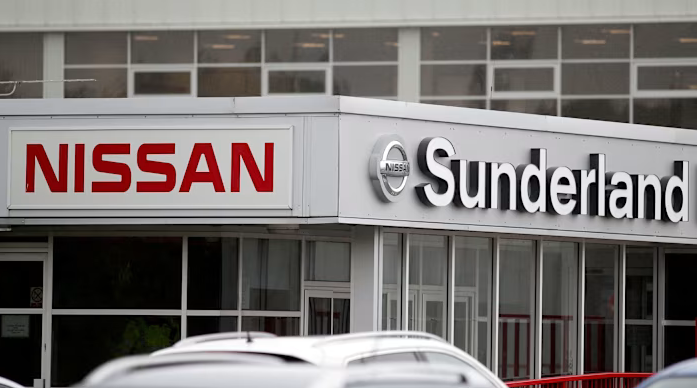
Nissan UK Sunderland plant Financial Times
SMMT data shows that the total production of cars, trucks and other vehicles in the UK in 2025 will be 764,700 units, a year-on-year decrease of 15.5%, setting a record low in 73 years, and more than half of the peak of 1.7 million units during Brexit in 2016. Hawes even called 2025 "the most difficult year in a generation."
Last year, Stellantis closed its truck factory in Luton; BMW also suspended its 600 million pound investment plan to produce electric MINI in Oxford; local brand Jaguar Land Rover also shut down its factory for more than a month due to a cyber attack, resulting in a loss of more than 200 million pounds.
Among them, as one of the largest automotive employers in the UK, Nissan's Sunderland plant has about 6,000 workers and provides another 30,000 jobs for the overall supply chain. Nissan has invested 6 billion pounds in the Sunderland plant, but its capacity utilization has been hovering around 30% due to weak demand. Sources familiar with the matter have warned that it could pose an existential threat to Nissan if it is frozen out of EU incentives.
New options?
But it is worth mentioning that under heavy pressure, the British automotive industry is not without gains, and some new opportunities are emerging.
In February this year, Chery, China's largest passenger vehicle exporter, stated that it would launch its new energy overseas brand Lepas in the UK in the next few months. During British Prime Minister Starmer's visit to China, Chery Commercial Vehicles also signed a cooperation agreement with the Liverpool City Council in the UK to set up its European headquarters in Liverpool to support engineering and software development. This is also Chery's first headquarters project in Europe.
Including Chery, 10 Chinese brands have launched and sold cars in the UK. Among them, SAIC MG's cumulative sales in the UK's "home" have exceeded 370,000 units, and pure electric vehicles alone have exceeded 100,000 units. Chinese brands including NIO, GAC Aion and Jikry also plan to launch new cars in the UK this year.

Chery New Energy Brand Lepas Chery Automobile
The main reason why Chinese cars have aggressively entered the British market in recent years is precisely because the UK, unlike the EU, has not imposed countervailing tariffs of up to 37.5% on electric vehicles produced in China.
On the other hand, in order to revive the British automobile industry, which continues to decline, the British government has also set an annual production target of 1.3 million vehicles by 2035. But this also means that the British market must welcome an infusion of new blood. Hawes also said that with the current downturn in the traditional automobile industry, new automobile manufacturers must be introduced, and Chinese automobile companies are regarded as core potential partners.
According to the Financial Times, the British government has been actively seeking for Chery to produce cars in the UK in the past few years. Chery has been exploring the idea of using spare capacity at Jaguar Land Rover's British factories to produce cars under a proposal backed by the British government, people familiar with the matter said.
According to SMMT forecasts, UK automobile production is expected to grow by 10% in 2026, and may return to the 1 million level in 2027. In this process, whether Chinese electric vehicles can replace European and American companies and become a new booster for the UK is posing a new test to the British government and the British automobile industry.