Reuters quoted senior officials from Japan, France and Canada as saying on the 6th that the three countries are actively planning to build a new mechanism to replace the U.S.-led critical mineral alliance to ensure the supply of strategic minerals and reduce dependence on China.
According to reports, the alternative path proposed by the three countries covers three major directions: implementing import quotas on specific rare earths, providing supply chain diversification subsidies for mining companies, and promoting the "buyers alliance" proposed by Canada.
Japan, France and Canada are starting anew, directly confronting the key mineral cooperation plan led by the United States. In February this year, the Trump administration just announced that it would unite allies and partners to form a "critical minerals alliance." U.S. Vice President Vance added at a meeting that he hopes member states will form a trade bloc among allies and partners to promote the expansion of key mineral production capacity in the region. The new trade area will also set a clear "price bottom line."
But just one month later, Japan, France and Canada were thinking of bypassing the United States. According to reports, this action exactly confirms Canadian Prime Minister Carney’s call that middle powers should work together in the context of U.S. President Trump’s alienation from allies.
Specifically, Japan is using financial subsidies as a starting point to promote project cooperation among allies. The Director of the Americas Division of Japan's Ministry of Economy, Trade and Industry said at the Toronto Mining Conference that Japan can improve the commercial competitiveness of these projects by subsidizing rare earth projects in the Western Hemisphere, allowing it to compete with China's rare earth industry.
At the same time, Japan has clearly required its manufacturing companies to reach commercial cooperation with rare earth projects jointly invested by allies such as Japan, France, Australia, and Canada. "These projects may not be the lowest cost, but now that the industry has recognized the need to strike a balance between risk and cost, adopting these projects is a good idea."
France takes the "G7+" concept as its core and tries to expand its cooperation territory. Benjamin Gallezot, the French government's interdepartmental representative in charge of strategic mineral supply affairs, said that the US plan is only one of the diversification paths, and "there are other feasible ways." France advocates two points: first, it does not pursue a unified policy; second, the establishment of mechanisms requires the participation of many countries, not only the G7, but also the "G7+".
In addition, France also proposed to implement an import quota system to limit the amount of metal imports by companies and force companies in specific industries to diversify their supply chains. Gallezo revealed that France supports Canada’s “Buyers Alliance” concept and will promote the implementation of the plan during the G7 rotating presidency this year.
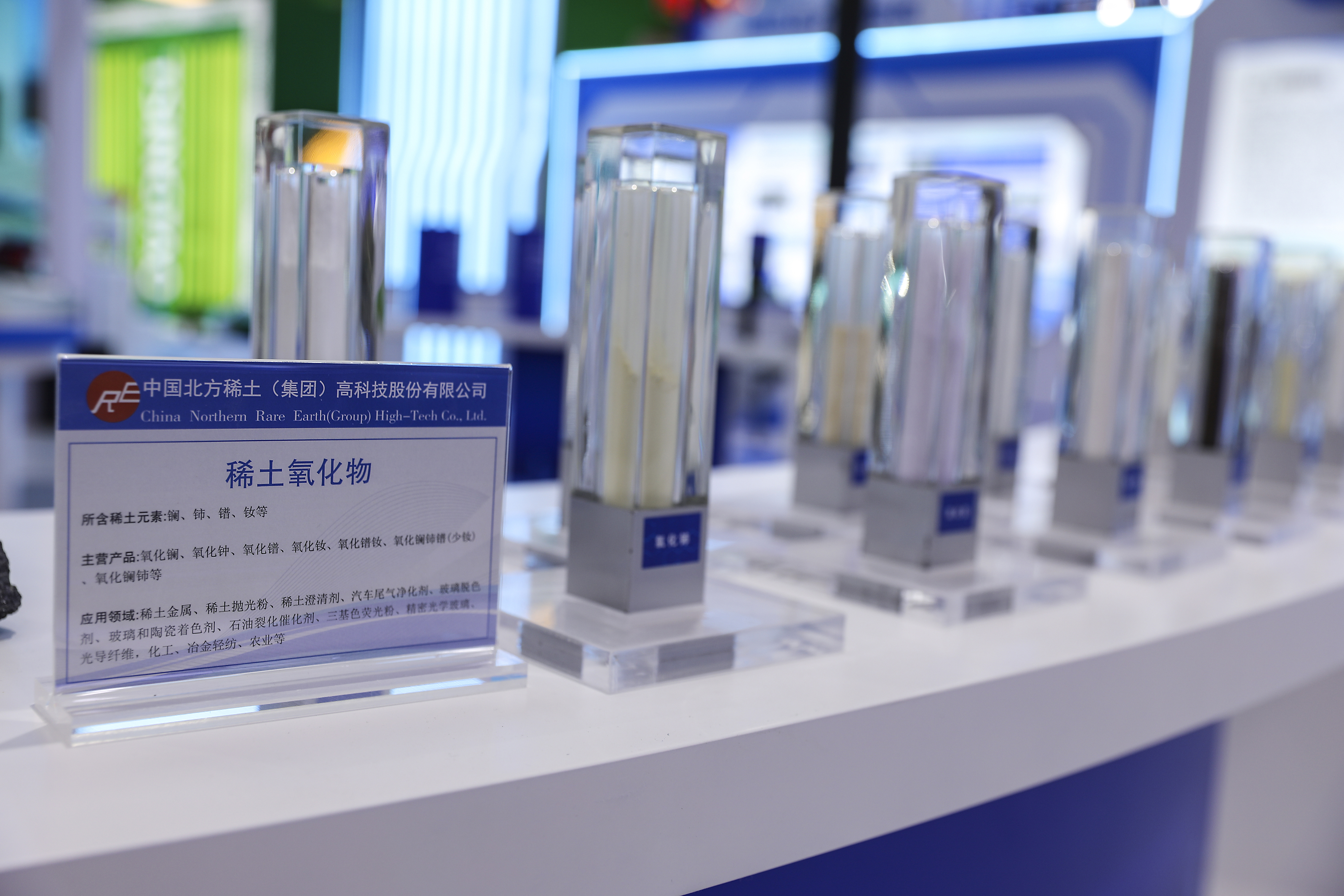
On May 12, 2024, in Shanghai, China Brand Day was held at the World Expo Complex. "Baotou Steel Group" booth, Northern Rare Earth. IC photo
Canada has recently signed 30 new agreements with 12 countries and plans to invest 12.6 billion Canadian dollars (equivalent to approximately 64.06 billion yuan in RMB) in mining and mining technology research and development. Since October last year, the total related investment has reached approximately 18 billion Canadian dollars (equivalent to approximately 91.51 billion yuan in RMB).
On March 5, Carney announced during his visit to Australia that the two countries had signed a series of critical mineral cooperation agreements, including Australia's joining the G7 critical mineral production alliance.
Australian Prime Minister Albanese also said on the same day that Australia and Canada agreed to deepen cooperation in multiple areas and further advance bilateral relations based on the statement of intent on cooperation in key minerals signed last year. The two sides agreed to strengthen cooperation in the field of critical minerals through four major measures: coordinating positions on important issues of critical minerals, strengthening collaboration between Australia's strategic reserves of critical minerals and Canada's defense reserve system, jointly promoting the development of emerging markets, and Australia joining the G7 critical minerals production alliance led by Canada.
Albanese also mentioned that the upgraded key minerals agreement is fully in line with the "Australia's Future Manufacturing" agenda. Both sides are working hard to promote diversified trade relations to ensure that relations will not break down due to the impact of a specific country.
Canadian Energy and Natural Resources Minister Hodgson has said that the most effective way to deal with the highly concentrated supply of critical minerals is to establish a production alliance or a buyer alliance, rather than simply setting a price bottom line.
Reuters pointed out that rare earths are metals that are extremely difficult to extract and are known as "industrial vitamins". They are indispensable resources for countries to transform traditional industries and develop high-tech and cutting-edge defense technologies. Its application scope covers metallurgical machinery, petrochemical industry, light industry and agriculture, electronic information, energy and environmental protection, aerospace, national defense and military industry and other fields. It is also a key mineral that supports the development of new energy and new material industries. Over the past 30 years, China has been the dominant player in rare earth mining and refining.
According to data from the International Energy Agency, China will account for more than 60% of global rare earth mineral production in 2023, but its control over the processing stage accounts for 92% of global production, and it has almost monopoly control in the global rare earth processing field.
In the past two years, many G7 countries have launched a number of measures in an attempt to curb China's dominance in the rare earth field. The spokesperson of the Chinese Ministry of Foreign Affairs has previously made clear its position on the G7 "Critical Minerals Production Alliance". China has standardized and improved the export control system in line with common international practices, with the purpose of better maintaining world peace and regional stability, and fulfilling international obligations such as non-proliferation. We urge the G7 to earnestly abide by the principles of market economy and international economic and trade rules, stop using "small circle" rules to undermine the international economic and trade order, and jointly safeguard the stable development of the world economy.