Financial News Agency, March 8 (Editor Niu Zhanlin) In the coming week, investors will pay close attention to how the war in the Middle East will spread and how much impact it will have on energy supply. They will also need to digest the latest U.S. inflation data that will be released soon.
After the United States and Israel launched attacks on Iran and the conflict spread to many countries in the Middle East, the attention of the global market will be focused on the latest developments in the situation in the Middle East.
This conflict has become a core variable in financial markets. The surge in oil prices has triggered sharp fluctuations in various assets and prompted investors to significantly lower their expectations for an interest rate cut by the Federal Reserve.
The S&P 500 index fell 2% this week, Wall Street's fear indicator VIX hit a nearly one-year high on Friday, and the weak U.S. non-farm payrolls report made U.S. stocks even worse.
Investors are currently weighing between two forces: on the one hand, historical experience shows that stock markets tend to rebound after major geopolitical shocks; on the other hand, the future direction of the situation in Iran remains highly uncertain.
Rick Meckler, a partner at Cherry Lane Investments, said: "This is a very significant event and the direction seems extremely uncertain, which to some extent makes investors reluctant to sell or buy."
One focus of market attention is the conflict-induced surge in energy prices and its impact on inflation and economic output. The fighting has paralyzed shipping in the Strait of Hormuz, which carries about a fifth of the world's oil and liquefied natural gas supplies.
Brent crude oil exceeded US$90 a barrel on Friday, a sharp surge from US$70 before the war began. Higher oil prices could weigh on the stock market outlook in a number of ways, including translating into higher gasoline prices that weaken consumer spending.
Michael Arone, chief investment strategist at State Street Investment Management, said, "In the short term, oil price trends will become an important barometer for judging the performance of risk assets." He added that oil prices exceeding $100 per barrel will be a psychological barrier and the market may become more panicked.
Dominic Pappalardo, chief multi-asset strategist at Morningstar Wealth, said that entering next week, "developments in the Middle East will really affect all financial markets."
Inflation data will also be a focus on Wall Street. The U.S. CPI for February will be released next Wednesday. The previously released January data was unexpectedly lower than market expectations. The Fed's favorite inflation measure, the PCE price index, will also be released next Friday.
If the inflation data is benign, markets may not read too much into it because the reporting period almost entirely precedes the conflict in the Middle East. But an unexpected spike in inflation could pose particularly thorny problems.
Isaac Stell, investment manager at Wealth Club, said: "The unexpected decline in employment coincides with the accumulation of inflationary pressures, leaving policymakers facing a difficult trade-off. Uncertainty still dominates the market environment, which makes it more difficult for companies to make plans and makes policymakers' outlook more unclear."
Investors have recently postponed their expectations for the next Fed rate cut due to concerns that energy prices are driving up inflation. However, weak employment data on Friday has re-raised expectations for a rate cut to a certain extent. The market currently expects a 45% probability of the Federal Reserve cutting interest rates by at least 25 basis points at its June meeting.
Pappalardo said: "If energy prices continue to rise and raise inflation concerns, it will be significantly more difficult for the Fed to implement these two interest rate cuts in 2026."
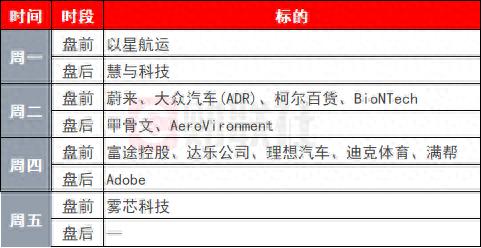
In terms of financial reports, the Q4 financial reporting season has come to an end. The performance of Li Auto, NIO, Kohl's Department Store, Futu Holdings, Oracle and other companies next week deserve investors' attention.
It is worth noting that starting next week, North America will begin to implement daylight saving time, and the financial market trading hours and economic data release times in the United States and Canada will be one hour ahead of winter time.
Overview of important events next week:
Monday (March 9): Japan’s January trade balance, China’s February CPI annual rate, the Eurozone’s March Sentix investor confidence index, the United States’ February New York Fed 1-year inflation expectations, domestic refined oil products will open a new round of price adjustment window
Tuesday (March 10): Germany’s January seasonally adjusted trade balance, the US February NFIB small business confidence index, the US February existing home sales annualized, the US February existing home sales annualized, China’s February M2 money supply annual rate, the US Department of Commerce held a roundtable meeting of US robot manufacturers
Wednesday (March 11): US API crude oil inventories for the week to March 6, US unseasonally adjusted CPI annual rate in February, US February seasonally adjusted CPI monthly rate, US EIA crude oil inventories for the week to March 6, OPEC releases monthly crude oil market report
Thursday (March 12): U.S. 10-year Treasury bond auction to March 11, U.S. initial jobless claims for the week to March 7, U.S. January trade balance, U.S. EIA natural gas inventories for the week to March 6, IEA releases monthly crude oil market report
Friday (March 13): UK three-month GDP monthly rate in January, Eurozone industrial output monthly rate in January, US January core PCE price index annual rate, US January personal expenditure monthly rate, US fourth quarter real GDP annualized quarterly rate revision, US January durable goods orders monthly rate, US JOLTs job vacancies in January, US initial one-year inflation rate expectations in March, US University of Michigan consumer confidence index initial value in March
(Niu Zhanlin from Financial Associated Press)