Recently, clusters of epidemics have occurred in many places in China, and international geopolitical instability has increased significantly, which has affected the production and operation activities of Chinese enterprises to a certain extent. In March, the manufacturing purchasing managers index, non-manufacturing business activity index and composite PMI output index all fell to the contraction range, indicating that the overall prosperity level of my country's economy has declined. But analysts remain optimistic about the mid- to long-term prospects of the Chinese economy. Experts predict that in the coming months, the government will introduce stronger fiscal policies and looser monetary policies to further boost economic growth.
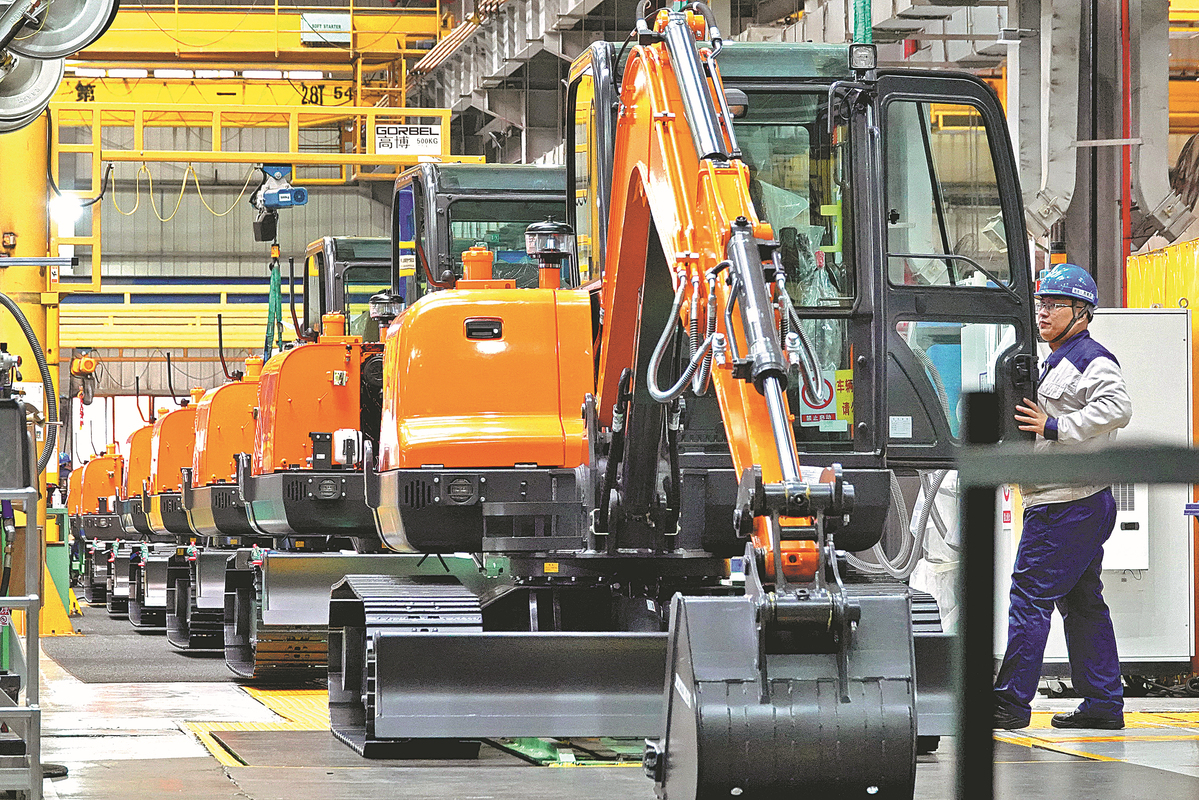
An employee works on the production line of an engineering equipment manufacturer in Yantai, Shandong province.
Photo by Tang Ke/for China Daily
China's manufacturing activities contracted in March for the first time in five months due to various uncertainties and negative impacts from home and abroad. Affected by multiple uncertainties at home and abroad, China's manufacturing activities contracted in March for the first time in five months.
However, analysts and officials remain upbeat about the medium- and long-term prospects of the Chinese economy, as the country still has room for macro policy fine-tuning and adjustments. However, analysts and officials remain upbeat about the medium- and long-term prospects of the Chinese economy, as the country still has room for macro policy fine-tuning and adjustments.
They expected a stronger fiscal policy and more easing monetary measures in the coming months to further shore up growth, including tax reductions, more infrastructure investment, and interest rate and reserve requirement ratio cuts.
The purchasing managers index for China's manufacturing sector stood at 49.5 in March, compared with 50.2 in February, data from the National Bureau of Statistics showed, slipping into contraction after staying in expansionary territory for four consecutive months. China's manufacturing PMI began to decline after maintaining an expansion trend for four consecutive months. PMI takes 50 points as the "water mark between prosperity and contraction".
The nonmanufacturing PMI, which covers the services and construction sectors, was at 48.4 versus 51.6 in February, slipping into contraction for the first time in seven months, according to the NBS.
Zhao Qinghe, a senior statistician with the NBS, said the resurgence in COVID-19 cases that affected some areas has dealt a blow to service sectors, such as transportation, accommodations and catering.
For manufacturers, the resurgence has affected the production and operation of some enterprises, and the escalating geopolitical tensions led to a decline in or the cancellation of export orders, Zhao said.
Zhao added that midstream and downstream enterprises are also facing pressure from the rising costs of raw materials, with surging commodity prices clouding the outlook. He said that midstream and downstream enterprises are also facing pressure from the rising costs of raw materials, with surging commodity prices clouding the outlook.
However, businesses remained upbeat about future business prospects, Zhao said. The enterprises surveyed said that suppressed demand and production would gradually recover with the government's effective measures to control the pandemic, and the market is likely to rebound. The surveyed companies reported that as the epidemic is effectively controlled, suppressed production and demand will gradually recover, and the market is expected to pick up.
Despite the downward pressures, Luo Zhiheng, chief economist at Yuekai Securities, highlighted that the high-tech manufacturing PMI had stayed in expansionary territory, saying this indicates the steady progress of economic transformation and high-quality development.
Luo said the current economic situation requires a proactive fiscal policy, such as promoting the issuance of local government special bonds to accelerate infrastructure construction and stabilize investment, and more efforts should also be made to ensure the basic livelihood of people affected by COVID outbreaks.
Wu Chaoming, deputy director of the Chasing International Economic Institute, estimated that the manufacturing PMI reading may expand above the 50-point mark in the following months with the help of the government's effective measures to control the pandemic and stabilize growth.
Experts said the intensifying economic headwinds could persuade the People's Bank of China, the country's central bank, to launch near-term easing measures such as cutting the reserve requirement ratio and policy interest rates.
At its first-quarter monetary policy committee meeting, the PBOC declared its determination to stabilize the economy by pledging "more substantial support" for the real economy and efforts to improve the transmission mechanism of monetary policy, according to a statement released on Wednesday.
The statement highlighted the emerging challenges posed by escalating geopolitical tensions and more frequent domestic COVID-19 outbreaks, in addition to the lingering pressures from shrinking demand, supply shocks and weaker expectations.
Yu Yongding, a senior economist at the Chinese Academy of Social Sciences, said China should stick with a fairly expansionary monetary policy to ensure the stabilization of growth, in spite of overseas central banks' interest rate hikes and potentially higher inflationary pressure.
"The risk of inflation has risen due to changes in the international environment. But monetary tightening won't be the sensible solution to inflation caused by supply shocks," Yu said.
If inflationary pressure worsens amid restrictions on the global commodity supply, responsive measures other than monetary policy should be taken, as tightening monetary policy in such circumstances risks triggering deflation, said Yu, who is also a former member of the PBOC's monetary policy committee.
It is advisable for the PBOC to further ease credit conditions to tide over small and medium-sized enterprises amid difficulties while supporting infrastructure investment by reducing the financing costs of related government bonds, he added.