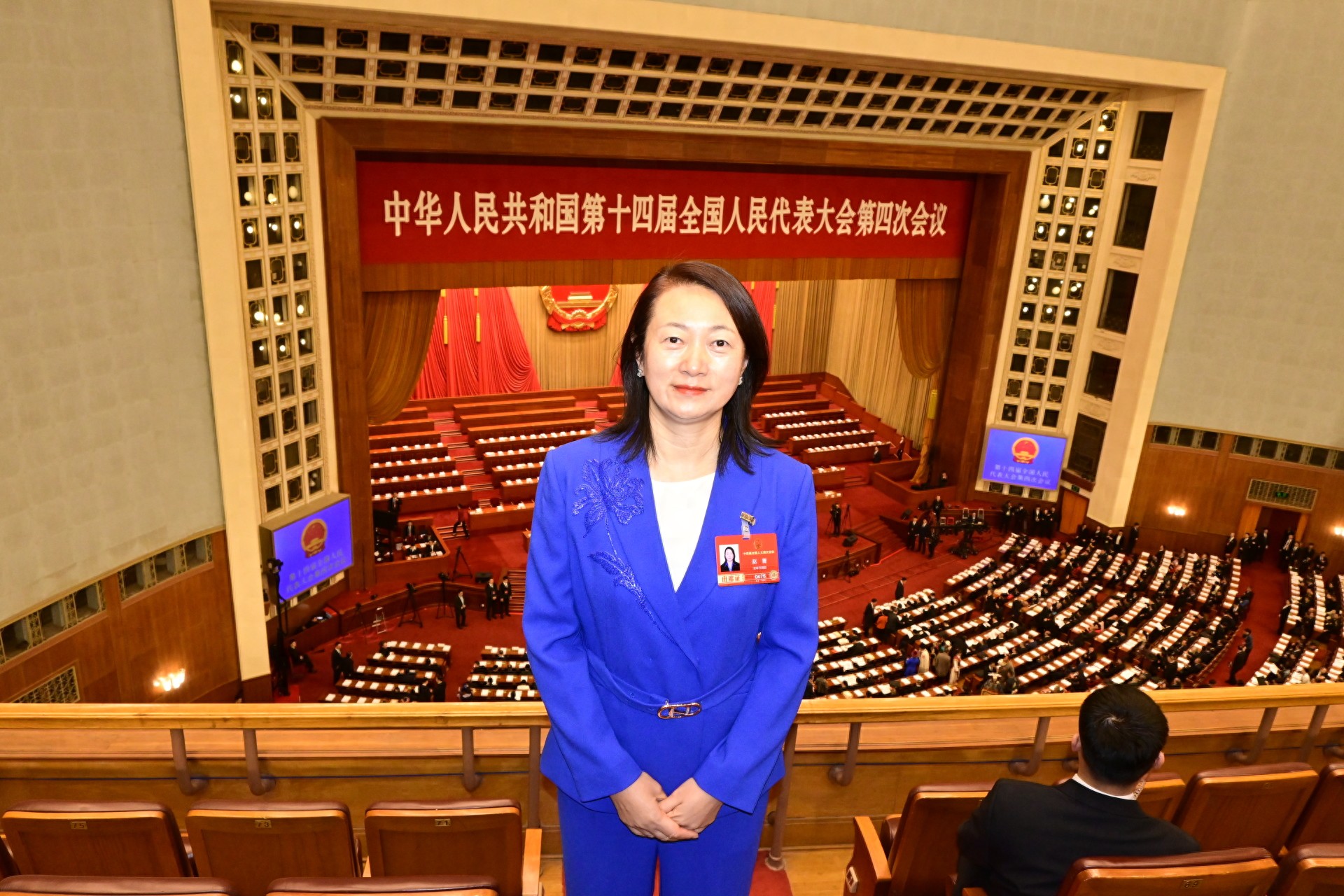
On the evening of March 6, Liu Qingfeng, deputy to the National People's Congress and chairman of iFlytek, was interviewed by the media at the Anhui News Center of the 2026 National Two Sessions in Beijing.
Talking about the way for China's large-scale model companies to break through against the background of increasingly fierce global artificial intelligence competition and facing multiple challenges from technical limitations and industrial dimensions, Liu Qingfeng said that the key lies in achieving full-stack independent controllability from algorithms, data to application scenarios.

Liu Qingfeng, deputy to the National People's Congress and chairman of iFlytek. Picture/Jiupai News
He pointed out that many models are currently trained based on foreign computing power and do adaptation and inference research on domestic computing power. This model still has security risks at the autonomous and controllable level. "A truly autonomous and controllable model should be trained on one's own computing power. Only after training on one's own computing power can a more complete autonomous ecosystem be formed. I think our safe future is guaranteed."
In his view, domestic computing power training has made continuous progress in the past year. "Although Spark is still the only mainstream model for domestic computing power training today, more and more special models and model manufacturers have begun to adapt artificial intelligence to domestic computing power, and have also begun to enter the training of base models."
Based on these developments, he showed firm confidence: "China's own computing power continues to develop, algorithms continue to adapt, and we are making our own innovations. Coupled with our rich application scenarios and the advantages of software and hardware integration, China's artificial intelligence can not only achieve independent controllability during the '15th Five-Year Plan', but also has a very broad future."
Jiupai News special correspondent Li Kai and Yan Huayang reported from Beijing
Editor Xiao Jie Ren Zhuo