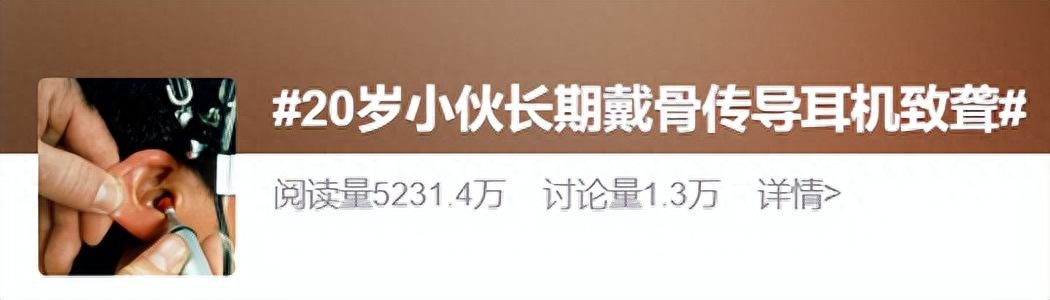
Recently, media reported that Xiao Li, a 20-year-old sports expert, has been frequently troubled by tinnitus recently due to long-term wearing of bone conduction headphones while working out. He was diagnosed with noise-induced deafness when seeking medical treatment. The doctor also said that sensorineural hearing loss is difficult to reverse if it declines steadily for more than 6 months.
Related topics quickly became hot searches. In many people's perception, bone conduction headphones are often labeled as "not damaging the ear canal" or "protecting hearing" due to their special open-ear design. However, Chen Jinxia, deputy chief physician of the Department of Otolaryngology and Head and Neck Surgery at Nanjing Tongren Hospital, reminded that this is not a "hearing safe" and improper use may still cause irreversible hearing damage.
Deafness as defined clinically is not “complete inability to hear” as we think. Chen Jinxia explained that as long as the hearing loss exceeds the normal range, that is, exceeds 25 decibels, it is defined as deafness. "Clinical deafness is divided into mild, moderate, severe and profound. Once it reaches moderate or above, it will significantly affect normal communication. Therefore, don't wait until you can't hear completely to realize the seriousness of the problem."
Theoretically speaking, bone conduction directly transmits sound wave vibrations through the skull to the cochlea of the inner ear. It bypasses the outer and middle ears, protects the eardrum, and avoids ear canal discomfort or middle ear fatigue that may be caused by wearing in-ear or headphones for a long time. However, the risk of damage to the inner ear still exists.
Not long ago, Chen Jinxia treated a college student who developed tinnitus and hearing loss because he often wore headphones to listen to music for several hours at a time and the volume was relatively loud. After seeking medical treatment, a hearing test revealed high-frequency sensorineural deafness and neural tinnitus, and he was diagnosed as noise-induced deafness. "Due to his timely medical treatment, his hearing gradually recovered after a month of active treatment, but some symptoms of tinnitus remained. This is because noise-induced deafness is essentially sensorineural deafness. The treatment cycle is long, recovery is slow, and the effect is not good. Even after timely and active treatment, some patients still cannot fully recover."
In Chen Jinxia’s view, the key to hearing loss does not lie in the type of headphones, but in the intensity and duration of use. "If the volume of headphones is too loud, especially more than 60% of the maximum volume, and the use time is too long, for example, for more than 60-90 minutes, the excessive vibration energy will also over-stimulate and damage the hair cells of the inner ear. Once this damage occurs, it is irreversible in some cases."
Once noise-induced deafness is diagnosed, there is a strict "golden window period" for intervention and treatment. "Seeing a doctor promptly within 72 hours after the onset of illness has the highest possibility of hearing recovery. If the best window of 72 hours is missed, it is best not to exceed a month. After active treatment, hearing will usually improve to varying degrees. Once the hearing loss exceeds half a year or even a year, further intervention will often have little effect."
Chen Jinxia said that if irreversible hearing damage has occurred, it is recommended to adopt a "long-term hearing protection and intervention" strategy: People with moderate and above hearing impairment can wear hearing aids, and patients with severe to extremely severe hearing loss can consider cochlear implants. "In daily life, once these people need to enter a noisy environment again, they must wear professional noise-reducing earplugs or earmuffs to prevent their hearing condition from further deteriorating."
Chen Jinxia reminded that the "60-60 principle" should be followed when using headphones, that is, the volume is ≤60% and the duration is ≤60 minutes. At the same time, it is recommended to do a pure tone audiometry every 6-12 months to monitor hearing changes. If symptoms such as tinnitus, ear fullness, hearing loss, or dizziness occur after using headphones, you must stop using the headphones immediately, avoid contact with noisy environments again, and go to the hospital for treatment as soon as possible.