Consultation hotline
Yongan Futures Programmed Trading Headquarters Phone Number
0571-88370913
Organizer
special support
Guest speech
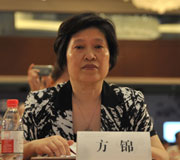
Fang Jin, chairman of Yongan Futures Brokerage Co., Ltd., pointed out at the meeting that with the listing of stock index futures, quantitative trading will become increasingly popular among domestic investors due to its characteristics of effective risk control. In the future, quantitative investment program trading will be a blue ocean market.
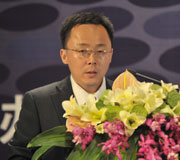
Yu Yinglei: High-frequency trading in financial markets is very important
Yu Yinglei, vice president of Wellington Asset Management in the United States, pointed out at the meeting that the competition in tactics and speed of high-frequency trading is becoming increasingly fierce. In modern financial markets, high-frequency trading plays an increasingly important role in providing liquidity and reducing transaction costs.
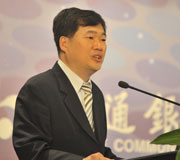
Yang Yongbin: The Chinese market will push options in the future
Yang Yongbin, deputy general manager of Beijing Shiyingtong Asset Management Company, said at the meeting that options will be launched in the Chinese market in the future, and the primary market must prepare for the launch of options in advance and seize the opportunity to obtain considerable profits.
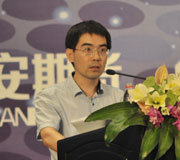
Luo Rongge: The success of the options market depends on liquidity
Luo Rongge, business architect of the System Planning Office of DCE, pointed out at the meeting that the liquidity of the options market is very important. Whether the options contract has sufficient liquidity and market depth is a key factor in the success of the absolute options market.
roundtable discussion
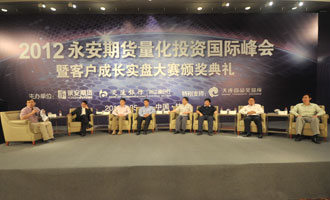
Discussion on the mainstream issues of domestic quantitative and programmatic trading
Speakers:
Liu Ning: Manager of Yongan Futures Programmed Trading Headquarters
Ding Peng: Senior quantitative strategist at Founder Fubon Fund
Li Guodong: R&D Director of Bohongshujun Company
Louis liu: Chinese American, founder of Cycpartner
Hang Guoqiang: Chairman of Shanghai Fanjin Investment Management Co., Ltd.
Wu Zhuanpu: Founder of Putian Investment Institution
Feng Zhengping: professional investor
Wang Li: Co-founder and Chief Investment Officer of Hangzhou Longqi Technology Co., Ltd.
According to Hexun.com, on August 25, the “Yongan Futures Quantitative Investment International Summit” was held in Hangzhou. Liu Ning, manager of the programmatic trading headquarters of Yongan Futures, Ding Peng, senior quantitative strategist of Founder Fubon Fund, Li Guodong, R&D director of Bohong Shujun Company, Louis liu, founder of Cycpartner Company, Hang Guoqiang, chairman of Haifanjin Investment Management Co., Ltd., Wu Zhuanpu, founder of Putian Investment Institution, professional investor Feng Zhengping, co-founder and chief investment officer of Hangzhou Longqi Technology Co., Ltd. Wang Li, etc. conducted a round-table discussion on the mainstream issues of "domestic quantitative and programmed trading".



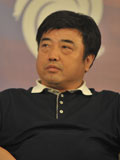


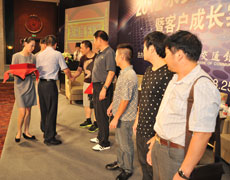
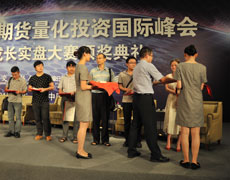
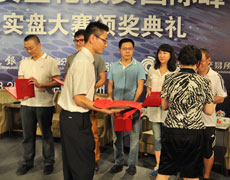
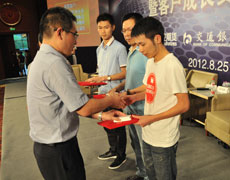
Wing On Trading Competition Award Ceremony
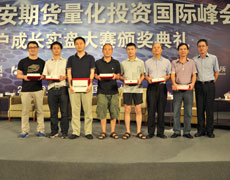
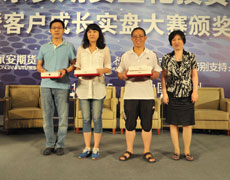
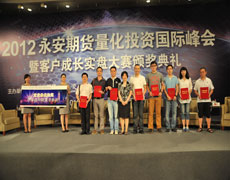

Speaker introduction
Yu Yinglei
CFA, Vice President of Wellington Asset Management. He received an MBA with the highest honors from the University of Chicago, majoring in analytical finance, a master's degree in electrical engineering from the University of Michigan, and a bachelor's degree in physics from Peking University. He is now a certified financial analyst in the United States. Mr. Yu Yinglei has been responsible for derivatives quantitative asset investment for a long time. The investment asset categories cover futures, options, stock indexes, volatility indexes, stocks, commodities and other fields. He has rich experience in model design, quantitative investment, risk arbitrage, derivatives hedging, risk management, etc. Wellington Asset Management was founded in 1928 and ranks among the top ten in the world. It currently manages approximately US$700 billion in assets and serves as investment advisor to 1,900 institutional investors in more than 50 countries.
Yang Yongbin
Korean programmed trading expert, deputy general manager and investment director of Beijing Shiyingtong Asset Management Co., Ltd. Bachelor's degree in astronomy and master's degree in economics from Seoul National University, South Korea. He successively served as the director of the financial derivatives department of PAXNET, a Korean securities portal, and the director of the financial engineering department of South Korea's DeltaExchange. He founded the investment management company Maximin System. He has served as a special lecturer on many occasions to train programmed trading for many Korean institutions such as Korea Securities and Futures Exchange, Daewoo Securities, and Asiana Securities. He is the author of the best-selling book "Practical Strategies for Futures and Options" (South Korea) and translated Jack Schwager's "The New Market Wizards" (South Korea).
Xu Haitao
General manager of Dalian Feichuang Information Technology Co., Ltd. Dalian Feichuang Information Technology Co., Ltd., as a wholly-owned subsidiary of Dalian Commodity Exchange, is responsible for the development and maintenance of the information system of Dalian Commodity Exchange, operation and management of market data of Dalian Commodity Exchange and computer room hosting, and is fully responsible for the construction and testing of large-scale projects of Dalian Commodity Exchange.
Liu Hong
Founder and CEO of Bohongshujun Investment. He began to engage in securities trading in 1990; in 1994, he founded Shenzhen Xindeli Company, the first digital financial information service provider in China; in 1996, he established Shanghai Xindeli Information Technology Co., Ltd. and led the development of the earliest programmatic trading system in China. With nearly 20 years of investment experience in securities, foreign exchange, and futures, he has forward-looking understanding and insight into the development of China's financial market. In years of practice, he has accumulated rich experience in trading strategy research and development, risk management, fund management and team management, and is known as the number one hedge fund in China.
Ding Peng
Ph.D. author of "Quantitative Investment-Strategy and Technology" and senior quantitative strategist of Founder Fubon Fund. Member of IEEE (International Institute of Electrical and Electronic Engineering), member of AFA (American Finance Association), special guest of CCTV Securities Information Channel, special writer of "First Financial News", special guest of NetEase Finance, deputy editor of "Quantitative Investment and Hedge Fund". He wrote the book "Quantitative Investment – Strategies and Techniques", which was the first textbook in the industry to comprehensively explain quantitative investment strategies. The book has become a classic textbook on quantitative investment in the industry. He once served as a senior analyst at the Financial Derivatives Headquarters of Orient Securities and developed the D-Alpha quantitative hedging system and several practical and effective quantitative investment strategies, achieving sustained and steady returns in practice.
Louisliu (Chinese name: Liu Feng)
Chinese American, founder of Cycpartner. Graduated from Columbia University in 1997 with a master's degree in operations research. He has worked in many well-known investment institutions on Wall Street such as BK (Bank of New York). Founded Cycpartner in 2006, focusing on quantitative investment and high-frequency trading in the US financial market. Adhering to the concept of applying the most cutting-edge technology to the field of financial transactions, he is committed to the research of trading models and the development of high-frequency programmed trading strategies, focusing on quantitative investment and high-frequency trading in the US financial market. The Cyc team has achieved an average annual income of over 50% since 2007.
Wu Zhuanpu
The founder of Putian Investment Institution and an expert judge in the previous R&D team evaluations of the Dalian Stock Exchange.
He served as the general manager of Heilongjiang Tianqi Futures Brokerage Co., Ltd. from 1997 to 2004. He has been engaged in the international trade of agricultural products for nearly 10 years. He is familiar with the properties of commodities, is proficient in all aspects of the circulation field, and has a broad international perspective. Mr. Wu Zhuanpu is good at using computer technology to improve the company's management and service levels. He has in-depth practical experience in fundamental quantitative investment. He adheres to the investment philosophy of "achieving long-term stable appreciation of assets under the premise of fully controlling risks". He has achieved good returns on investment over the years. The Putian database system website he built by himself has laid a good foundation for transaction research and development and quantitative transactions.
Hang Guoqiang
Chairman of Shanghai Fanjin Investment Management Co., Ltd. He once served as deputy general manager of Beijing Huaqin Investment Management Company (private equity fund), vice chairman of Shenzhen Guolong Investment Management Company, and general manager of Shenzhen Changrun Investment Management Company (private equity fund). With 20 years of investment experience, he has advocated the idea of programmed system trading for many years, adhering to the investment philosophy of "tracking trends and swing trading", constantly improving the trading system, conducting investment management objectively, systematically and scientifically, and striving for prediction and judgment with a high probability of winning. Over the past five years, the futures trading account has achieved good results.
Feng Zhengping
His online name is "Hummer" and he is a professional investor. He got involved in the investment market in 1997 and has been engaged in quantitative market research for a long time. In 2008, he began to specialize in stocks, futures, foreign exchange and other transactions, and developed a variety of trading strategies. In 2010, he began to study portfolio investment. Combining his statistical analysis of the market, he developed his own portfolio analysis method and developed it into an application. The average annual return rate of the developed programmatic model is much higher than the market average.
Wang Li
Ph.D., co-founder and chief investment officer of Hangzhou Longqi Technology Co., Ltd. Graduated from the Department of Computer Science of Tsinghua University, and then went to the United States for further study. He received a doctorate and four master's degrees in total. His research covered many fields such as finance, statistics, operations research, and computer science. His academic level has reached the world's leading level in fields such as data mining and artificial intelligence. Dr. Wang once worked for BlackRock, the world's top asset management company in the United States, as the chief fund manager and quantitative analyst in the Greater China region. He has extensive experience in quantitative investment. The quantitative investment model he developed controls the transactions of tens of billions of dollars in assets in Asia, emerging markets and North American stock markets.
meeting agenda
Yongan Futures Quantitative Investment Forum
Time: August 25, 2012 13:00-17:30 Address: Crystal Palace, first floor, Huanglong Hotel, Hangzhou
time
Speech Topic
Speaker
13:00—13:10
Leader's speech
13:10—14:10
American quantitative investment experience sharing
Yu Yinglei (USA)
14:10—15:10
Sharing of Korean stock index investment experience
Yang Yongbin (South Korea)
15:10—15:40
Options Trading Outlook
Luo Wing Court
15:40—15:55
tea break
15:55—17:30
Discussion on the mainstream issues of domestic quantitative and programmatic trading
Liu Ning, Ding Peng, Li Guodong, Louis liu, Hang Guoqiang, Wu Zhuanpu, Feng Zhengping, Wang Li
17:30—17:45
Yongan Futures Customer Growth Firm Trading Competition Award Ceremony
Wing On Programmed Trading

Yongan Futures Programmed Trading Services
Yongan Futures is one of the domestic futures companies with the largest scale, the widest business scope and the strongest research strength. Since its establishment, Yongan Futures has firmly ranked first in Zhejiang Province in terms of business scale. It is the only futures company in China that has been among the top ten futures companies in the country for 14 consecutive years.
Yongan Futures Programmed Services: Committed to providing world-class and domestically leading programmatic trading services.
In 2012, the company made every effort to build an elite programmatic trading and research support team. More than 60 research teams in Hangzhou, Beijing, and Shanghai worked together to bring together many experts in the field of programmatic trading.
Introduction to Yongan stock index hedging and arbitrage products
Yongan's research on hedging and arbitrage products has gone through three stages. The passive stock index futures and spot arbitrage trading system achieved excellent results in 2010. However, as the market matures, the opportunities and space for this passive basis arbitrage gradually disappear. Yongan people turned to proactive alpha arbitrage research and successively proposed stock valuation models and alpha momentum valuation models based on market data statistics.
Yongan Programmed Trading Wenzhou Station Ends Futures Investment Exchange Salon 3rd Issue Yongan Futures: Focus on Programmed Trading
Wing On Lecture Hall
Introduction to programmatic trading
Programmed trading (Program Trading) is a trading method that, with the support of computer and network technology, instantly completes your preset combination trading instructions. Each investor (or institution) can write his own trading model and conduct automatic computer trading based on his own investment experience and wisdom. The trading model is the condensation and practicalization of trading ideas. Correct trading ideas will obtain good and stable investment returns under the implementation of strict operating disciplines. The trading model is a good combination of correct trading ideas and strict operating disciplines to help people obtain good and stable investment returns. Programmed trading can not only increase the speed of order placement in actual investment operations.
Investment model of programmatic trading system
Key advantages of programmatic trading investment
1. Systematize the trading model, and the buying and selling decisions of programmed trading are completely determined by systematic and institutionalized logical judgment rules;
2. Overcome the four major psychological obstacles of human nature: fear, greed, hesitation and gambling;
3. To ensure the consistency of trading methods, use computers to write operating specifications, profit and risk management and other conditions into program language, and send out buying and selling signals according to the program.
1. Systematize the trading model.
2. Transaction risks are controllable.
3. Standardize trading disciplines.
4. Steady return on investment.
5. Rationalize fund management.
Advantages of programmatic trading Disadvantages of programmatic trading
Using programmed trading can overcome the weaknesses of human nature during the transaction process. This is the biggest advantage of programmed trading and the main reason why I love programmed trading. People have human weaknesses. Human emotional factors, greed, fear, indecisiveness, gambling and other factors will make a person suddenly change his original plan at the moment of trading. And this kind of behavior happens repeatedly, just as the German philosopher and psychologist Schopenhauer said, "It is inevitable that a person will make the same mistake under the same time and environmental conditions. This is the bad nature of human beings."
Only systematic traders can achieve programmed trading, while other types of trading methods cannot be completed using programmed trading, which blocks some people out. The instability of programmed trading: I think that programmed trading systems cannot conquer the world forever, and certain problems will always occur at specific times. Some people overestimate the effect of programmed trading and boast that it is magical, but there are also people who reject programmed trading, question its role, and think that using programmed trading to make money is a bit ridiculous like inventing a perpetual motion machine.
Basic process of programmatic trading strategy
Models and applications of programmatic trading
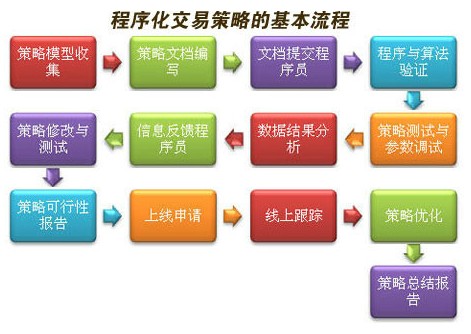
Programmed trading gradually evolved from the development of systematic trading in the U.S. securities market in the 1970s. According to the definition of the New York Stock Exchange (NYSE), any transaction that contains more than 15 stocks in the S&P 500 index, or is worth more than one million US dollars, is a programmatic transaction.
The definition of NYSE mainly emphasizes transaction size and concentration. However, with the development of program trading today, its meaning has far exceeded the original definition of the New York Stock Exchange. Now give programmed trading a more market-oriented definition: buying and selling signals generated by certain trading models and rules, and a trading process in which a computer automatically executes buying and selling instructions. That is, a computer program is used to control the timing of buying and selling and is automatically executed by the computer. In this definition, what stands out is the importance of trading models and computer programs to trading. Programmed trading based on a certain trading model is applied to real investment. In addition to speeding up the time efficiency of investment, it can also create additional income for us. This is the key to our study of programmed trading.
The impact of programmatic trading on the market The development trend of programmatic trading in the country
Years of exploration and practice have shown that programmed trading can help improve the operational efficiency of stocks, futures and other markets and increase market liquidity, so that the price discovery function of futures can be more fully utilized.
Therefore, we sorted out and analyzed the research results of CME Group, the largest futures exchange in the United States, the largest financial derivatives exchange in the world, and the second largest exchange for futures and options contracts, on the dynamic impact of program trading on the market.
The domestic securities market only has a history of 20 years, and there is still a big gap in market maturity compared with Europe, the United States and other developed regions in the Asia-Pacific. Not only that, some characteristics of the domestic market also restrict the development of programmatic trading in the country.
First of all, domestic trading venues are relatively single, and stocks are only traded on exchanges. Secondly, the T+1 delivery system in the domestic market makes it impossible to implement a large number of intraday trading strategies, and high-frequency trading strategies are even more out of the question. In addition, the stock market does not allow short selling and lacks a market maker system.
Hot discussion on Weibo