Tether's main goal is to maintain a price of $1, but there have been several significant price fluctuations in history.
For example: In 2017, due to the Taiwan Bank incident, the price fell to $0.91. In 2018, it fell to $0.9 due to the US government investigation.
But it is worth noting that after these events, the price of Tether is usually able to return to levels close to $1 within a short period of time.
Fourth, factors affecting market confidence
Tether’s stability largely depends on the market’s confidence in it. For example, government regulation may affect this confidence. Once market participants become uneasy about the reserves behind Tether or how it operates, prices can be subject to volatility.
Although Tether has been in existence for nearly 10 years, many price changes have always returned to the value of 1 US dollar "within 2-3 weeks".
However, investors still need to pay attention to relevant risks and market changes and should not take it lightly.

The principle of Tether (USDT)
It is stated in the white paper on the official website: Each Tether coin is worth equal to 1 US dollar and is 100% backed by Tether reserves. That’s why we call it a “stablecoin.” But how does it work behind the scenes?
First, when you use 1 USD to buy Tether, Tether Limited will deposit the 1 USD into a specific bank account as a reserve. In contrast, when you exchange Tether for U.S. dollars, the company will withdraw the equivalent amount of U.S. dollars from its reserves and destroy the USDT. This ensures that the total amount of USDT issued is always consistent with the total amount of USD reserves.
In short, the company Tether Limited acts like a middleman, providing us with a "USD play currency" that can be used in the cryptocurrency world. This model is very popular among cryptocurrency exchanges, especially when market prices fluctuate violently, Tether provides a relatively stable value anchor.
However, there are still some doubts and doubts. Although Tether Limited has always emphasized that each Tether coin is backed by US$1, there are still doubts in the market about the authenticity and adequacy of its reserves. One of the key questions at the heart of this is: If everyone wants to convert USDT to USD, does the company really have enough cash to support it?
This incident also reminds us of an important concept: currency is valuable because people generally trust it. Now, the market recognizes the value of Tether, but if trust is damaged, the value of Tether will also be seriously affected.
Tether uses advanced blockchain technology, which not only provides transaction transparency, but also ensures security. In addition, with the advancement of technology, Tether has been implemented on different blockchain platforms, such as: Ethereum and TRON, which means that there are multiple versions of USDT.
What will happen if there are "multiple versions" of USDT? Tether (USDT) has multiple versions on different blockchain platforms, just like a popular game has its own versions on different gaming platforms. So what does the existence of these multiple versions mean to us?
First, the convenience of transactions. First of all, multiple versions of USDT mean that it can be circulated on different blockchain networks. For example: when a person uses an exchange based on Ethereum, he will use the USDT version based on Ethereum, and on an exchange on the TRON network, he will use the USDT version based on TRON. This increases the convenience of transactions and allows users to easily switch between different platforms.
Second, enhanced liquidity because USDT can operate on multiple blockchains, which enhances its market liquidity. No matter which platform you are on, you can find USDT, which makes it a cross-platform "universal game currency".
Third, we should pay attention to the exchange issues. However, this also brings some minor troubles. Different versions of USDT are not directly compatible with each other. If you have Ethereum-based USDT but want to use it on the TRON network, you may need to exchange it through a specific bridge service or exchange.
Fourth, multiple guarantees of security. Each blockchain platform has its unique security features. Multi-version USDT means that the security behind it is multiple and not entirely dependent on a single blockchain platform. This provides an additional layer of security to some extent.
What are the risks of Tether (USDT)?
As one of the most popular stablecoins, Tether has a wide range of applications in the market, but there are many risks and questions behind it.
Risk 1. Opacity of financial data
In 2021, Tether reached an agreement with the New York Prosecutor's Office and promised to disclose its guarantee information. However, judging from the data it provides, its reserve information has not been formally audited and confirmed, and detailed information is relatively lacking.
Real cash accounts for less than 4% of published margins, while the majority of reserves (about 65%) are classified as commercial paper. However, specific details of the commercial paper were not disclosed due to "commercial reasons." This is the first risk of Tether.
Risk 2. Doubts arising from reserves
According to data disclosed by Deltec Bank, in the first nine months of 2020, Tether's foreign currency increased by US$600 million, but its Tether issuance increased by US$5.4 billion during the same period, a gap of nearly 7 times.
Tether's other reserves, such as mortgage loans and investments in Bitcoin, are mostly assets that cannot be cashed out quickly. This means that once there is a large demand for Tether exchanges, Tether may face payment difficulties, leading to a price drop or even a collapse. This is the second risk of Tether.
Risk 3. Legal and regulatory issues
Unlike other financial institutions, Tether's custodian bank Deltec does not purchase insurance specifically designed to protect investors, such as the FDIC or the Central Deposit Insurance Corporation. In other words, if Tether is subject to large-scale theft or loss, it will be difficult for investors to receive compensation.
Although Tether claims to have registered an MSB license, it has not actually obtained strict financial supervision, which may mean that there are risks in business operations and investors cannot fully rely on the information currently provided. This is the third risk of Tether.
Although Tether has an important position in the crypto market, the risks and opacity behind it are still areas that investors need to pay special attention to. The above three potential risks should be carefully considered before using Tether.

Is Tether (USDT) worth investing in?
Despite all the controversies Tether has experienced, its current position in the cryptocurrency market seems to remain solid. Many people believe that Tether is a safe and stable investment option, but is this true?
First of all, we cannot deny the huge influence of Tether. Since its launch, it has dominated the market and become the most popular stablecoin today. The daily transaction volume is "billions of dollars" and not even Bitcoin can match it. This widespread usage means that most people believe in its stability and will use it as a bridge for transactions.
However, the financial issues behind it cannot be ignored. Many critics point out that Tether's financial data is not transparent and are skeptical about its true reserve margin content. Although Tether claims to have sufficient reserves, the lack of public information makes it difficult to determine the authenticity.
But on the other hand, Tether’s popularity means it’s unlikely to disappear anytime soon. Many people choose to trust it, not only because it is convenient, but also because "everyone is using it." So despite the risks, many investors still think it's relatively safe to use funds as excess in the short term.
As for long-term investment, since the price fluctuations of USDT itself are very small, it may not be an option that can bring significant returns. If you are looking for high risk and high reward, other options in the cryptocurrency market, such as Bitcoin or Ethereum, will be more attractive.
In addition, although Tether itself is not a scam, it has indeed been exploited by many scammers. From fake exchanges, fraudulent APPs to various scams, criminals often use the name of Tether to commit fraud. Therefore, whether you choose to invest or not, you should remain vigilant, do not be easily tempted by good promises, and be sure to purchase from reliable sources.
How to make money by buying Tether (USDT)?
Many investors use Tether for arbitrage. So, how is arbitrage realized, and how to make money by buying?
Arbitrage is basically divided into "two major strategies": one is to use the "price difference" between multiple platforms, and the other is to obtain "time difference" income by holding for a long time.
First, multi-platform arbitrage requires investors to buy USDT at a low price on platform A and then sell it at a higher price on platform B. However, this strategy is relatively difficult in practice because investors need to have in-depth knowledge of multiple platforms and continuously pay attention to market price dynamics. Therefore, this strategy usually requires professional teamwork and is difficult for ordinary investors to operate.
As for the long-term holding strategy, its risks are closely related to market performance. Traditionally, when the price of Bitcoin falls, people may turn to buying Tether; and when the price of Bitcoin rises, investors may consider selling Tether. But as Tether continues to sell Tether coins, this arbitrage space is shrinking. In addition, in the financial services provided by some cryptocurrency exchanges (such as Binance), depositing Tether will earn annual interest of up to 10%. This is also a very good way to invest.
When it comes to how to buy Tether, investors can generally use "two channels": exchanges and over-the-counter transactions. Exchanges such as Binance, OKX, etc. provide direct purchase functions. OTC transactions include: B2C, C2C, and P2P methods.
What does “over-the-counter” cryptocurrency trading mean? Over-the-counter (OTC) transactions are transactions completed directly between buyers and sellers, bypassing traditional cryptocurrency exchanges. This method is mainly used to conduct a large number of buying and selling operations quickly and efficiently without causing excessive price fluctuations in the open market.
When we trade on a general cryptocurrency exchange, the buy and sell orders will be publicly displayed and will directly affect the market price. But in the case of large transactions, if a large amount of Bitcoin or Ethereum is suddenly sold, it may cause large price shocks in the market.
OTC transactions are designed to avoid this situation, allowing buyers and sellers to directly negotiate the price and conditions of the transaction and then complete the transaction safely and privately. This is especially useful for larger organizations! However, OTC trading also has its risks. Without centralized regulatory guarantees like exchanges, you will face a higher risk of fraud. Therefore, it is crucial to choose a reliable OTC trading partner and ensure the safety of the transaction!
FeaturesB2C
(Business to Customer)C2C
(Customer to Customer)P2P
(Peer to Peer)
describe
Directly from the trading platform to the user
Provide transaction services
Transactions are conducted directly between platform users,
The platform provides matching services
Through a decentralized approach,
Not tied to a specific platform
participants
Trading platform and individual users
between individual users
direct transactions between individuals
advantage
Standardization of transaction process,
User experience is relatively simple and intuitive
Provide more flexibility and choice,
Sometimes you can get a better price
Completely decentralized,
Provide maximum freedom and privacy
shortcoming
More dependent on trading platforms
Reliability and security
Users need to identify themselves
Reliable trading partner with higher risk
Without the protection of intermediaries,
Higher transaction risk and fraud risk
Where to buy Tether (USDT)?
Tether is currently the most popular stablecoin on the market and is widely traded with cryptocurrencies.
The following are the channels through which USDT can be purchased:
Channel 1. Trading through cryptocurrency exchanges
Many major cryptocurrency exchanges support trading of Tether.
Here are some well-known exchanges: Binance, OKX, Huobi, etc.
Through these exchanges, Tether can be purchased using other cryptocurrencies (such as BTC or ETH) or traditional fiat currencies (such as USD, EUR, JPY, etc.).
Channel 2: Through over-the-counter transactions
This is a method of trading outside of public exchanges.
Many large exchanges offer over-the-counter trading services, making it possible to buy Tether in large quantities without having a big impact on the market price.
Channel 3. Through P2P transactions
Some platforms allow users to trade directly with each other without going through an intermediary or exchange at all.
This usually involves the seller sending Tether directly to the buyer's wallet, and the buyer paying the seller via traditional payment methods.
Channel 4. Through cash/local transactions
Although this method is less common, in some areas, people will meet at a certain place and exchange cash for Tether.
Special note: before purchasing Tether, please be sure to confirm whether the channel you are using is reliable and safe. Also, please make sure your Tether is stored in a secure wallet and properly backs up your keys to prevent loss.
Tether (USDT) purchase tutorial
There are many crypto exchanges that support USDT. Next, I will take Binance, the largest exchange in China, as an example to introduce the registration and purchase methods in detail.
Android mobile APP download
Android phone users can directly use the browser to open the APP download address: https://static.jbzj.com/qkl/ba/baxz.html
Apple mobile APP download
Apple mobile phone users can check the tutorial below to register an overseas Apple ID, and then go to the Appstore to search for binance and download it.
Step 1: Create an Apple ID for Taiwan, China
Due to country restrictions on Apple mobile phones, we need to register an apple ID in Taiwan, China, before we can download the Binance software. Apple IDs in the United States and Hong Kong no longer work. Apple IDs in the US can only download the emasculated version of Binance. In Hong Kong, due to regulatory reasons, the apps of these exchanges may also be required to be removed from the Appstore. So our best option is to register an Apple ID in Taiwan, China.
1. Enter the official Apple account website through a browser search, find the small downward arrow in the upper right corner of the page, and click "Create your Apple ID".
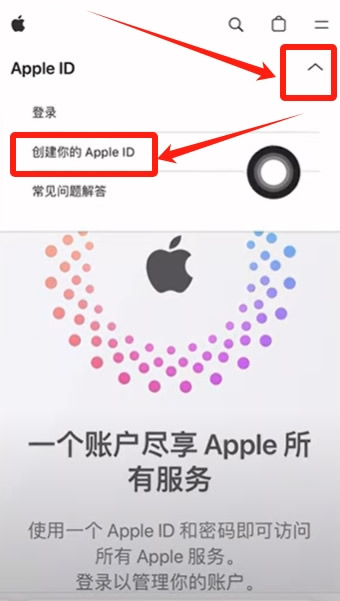
2. Fill in our [last name and first name]. Here we change the country or region from [Mainland China] to [Taiwan], and here we can make up any date of birth. The email address must be one that has not registered an Apple ID. Whether you have a domestic Apple ID or a foreign Apple ID, you must have never registered one.
3. Set up our Apple ID password again. At least 8 characters, including uppercase, lowercase and numbers.
4. Enter our mobile phone number. Because it requires verification, we need to receive text messages and voice calls, so we can just fill in whatever phone number we have.
5. Enter the verification code and click [Continue].
6. At this time, we will receive a verification code in our mailbox. We check it in the mailbox, enter the verification code, and click [Next].
7. Enter the mobile phone verification code again, and then click [Next].
8. Now comes a very important step. After we log in to our Apple ID, first click the downward arrow next to log out and find "Personal Information".
9. Find and click [Country or Region], and then click "Change Country or Region".
10. For the next country and region, we still choose Taiwan, China. We must select "None" for payment method and do not add any payment method. Next is the billing address and shipping address. Here we need to use the Taiwan address generator. Let’s not close this page yet, let’s open a new page first.
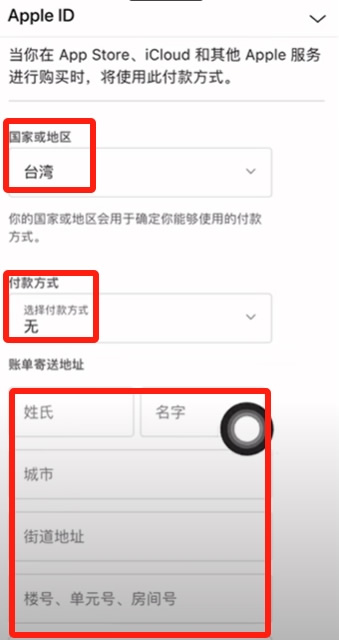
11. Directly search for "Taiwan Address Generator" and then open it.
12. Go to the Taiwan address generator page. Below is some randomly uploaded fake information. We can fill it in to the personal information page of our apple ID just now. Paste the name, city, street address, building number, unit number, zip code, area code and phone number. The area code is usually 886.
13. We don’t need to fill in the shipping address below again. Just click "Copy Billing Address" below, then click "Update".
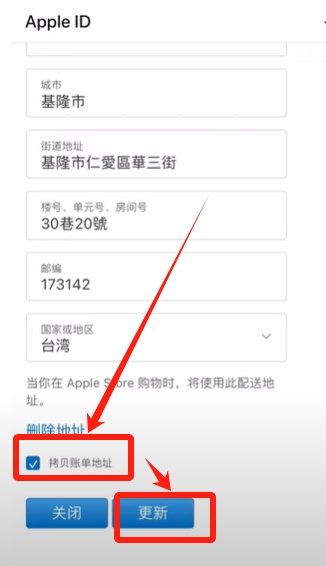
14. Now our Taiwan personal information has been entered. You now have a complete account with an Apple ID in Taiwan, China.
Step 2: Download and install the Binance Chinese version APP
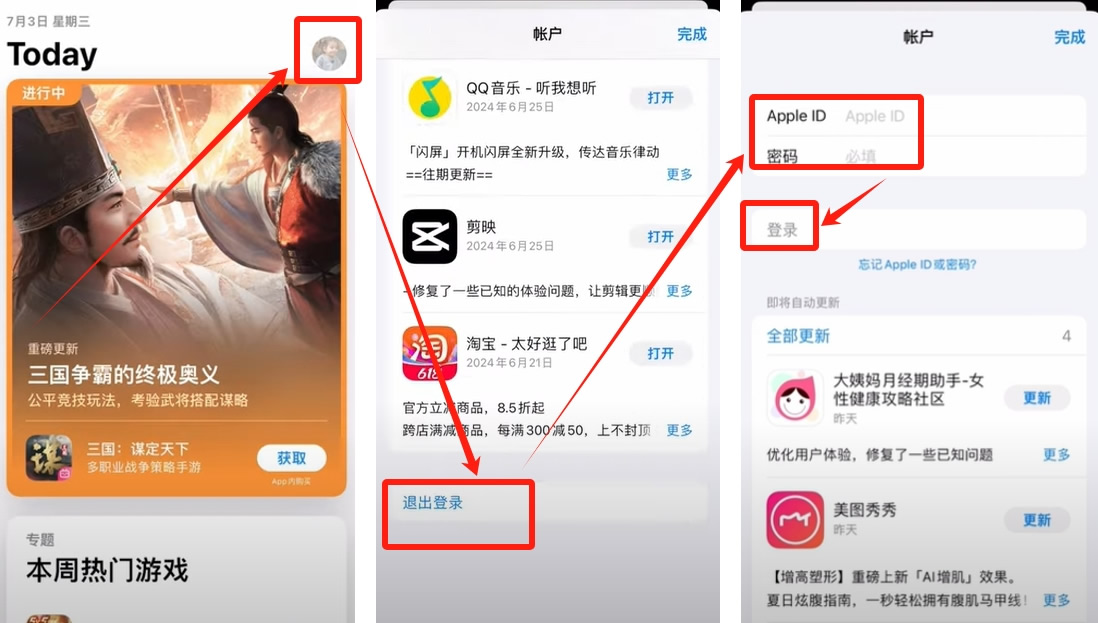
1. Next, we open the Appstore, click on the villain avatar in the upper right corner, scroll down and click [Log Out]. Go back again, fill in the apple ID and password we just registered here, and click [Login].
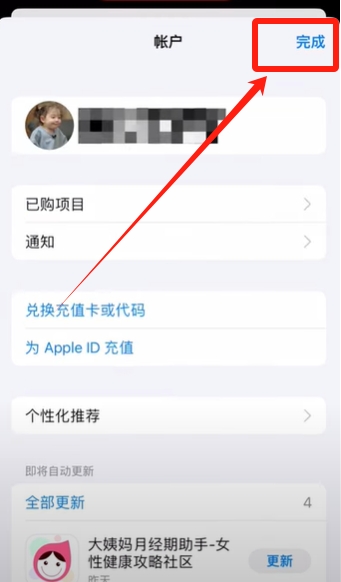
2. After logging in, click [Finish].
3. Search for "Binance" in the search box. The first one is advertising, we can leave it alone. We find Binance below and click to download.
4. Now our Binance APP has been downloaded successfully, click [Open]. Next we can use Binance normally.
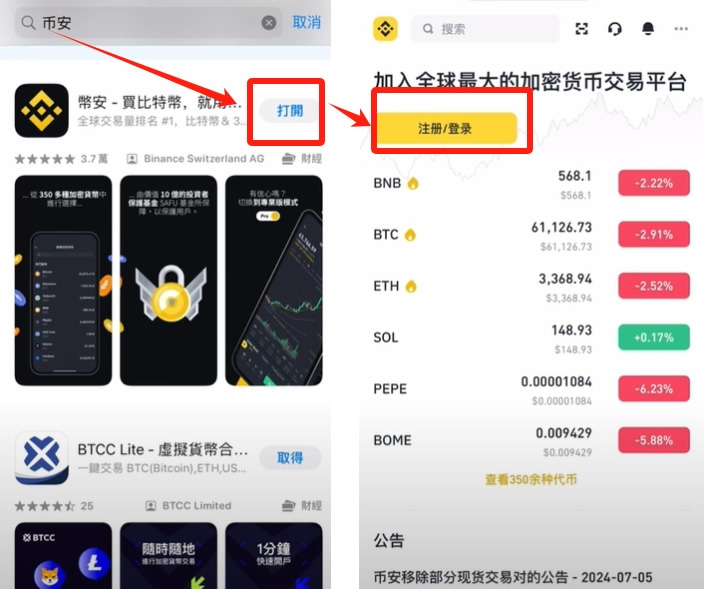
Tutorial on Binance account registration and purchasing USDT
1. After downloading, let’s register a Binance account (official registration, official download).
Open the Binance APP, click [Register] on the homepage, click "Create a Binance Account" in the lower left corner, and click [Register via email/mobile phone number]
2. You can directly enter our mobile phone number or email to register an account. You can fill in A0Y8K980 as the referral code here, so that you can get a permanent 20% fee reduction. This will help us save 20% in handling fees for each transaction we make later. It can help us save a lot of money virtually.
3. Complete the KYC identity verification of the account
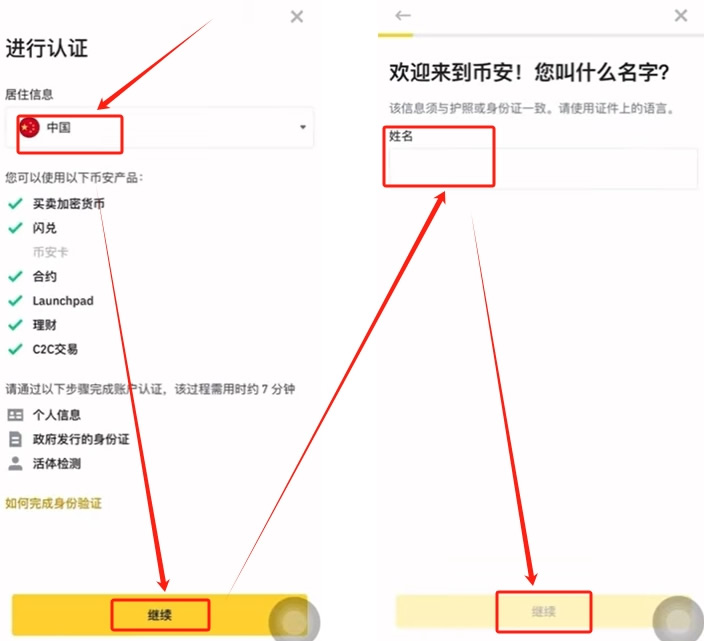
1. After registering a Binance account and logging in, he will ask us to authenticate our identity. Click [Go to Verification] on the homepage and click [Verify Now]
2. Select [China] as your country of residence, click [Continue], fill in your name, and click [Continue]
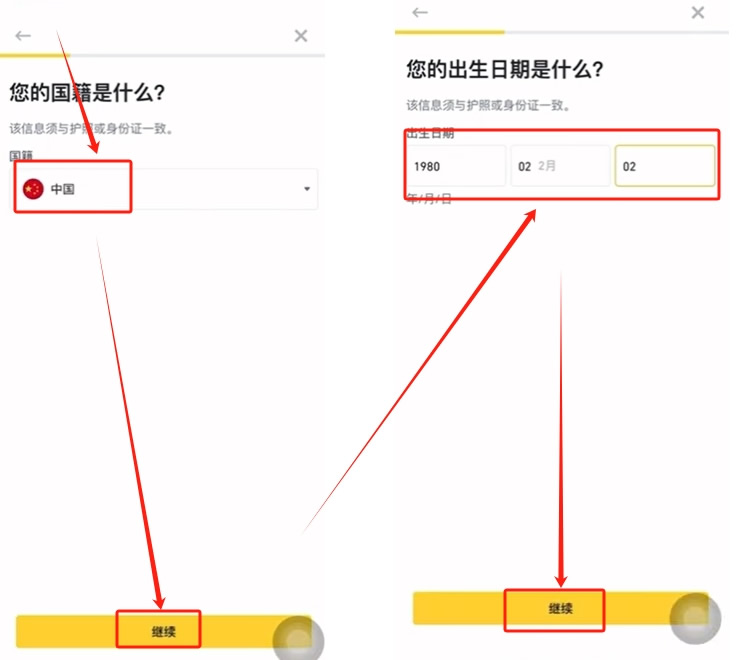
3. Select your nationality again, we just select [China], click [Continue], enter your date of birth, and click [Continue]
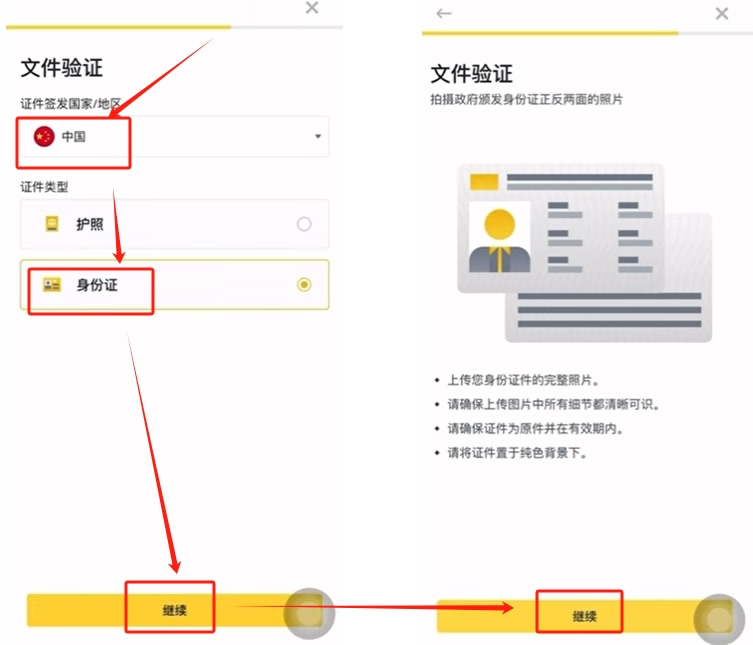
4. Select [China] as the document issuing country, select [ID card] as the document type, click [Continue], and then he will ask us to upload photos of the front and back of the ID card. Please upload it. Be sure to use real identity information, because face recognition is needed later.
4. Security settings (authenticator APP verification)
After the authentication is completed, everyone needs to perform security settings.
1. Click on the small four-square logo in the upper left corner. Click the small gear icon in the upper right corner, scroll down, and find [Account Security]
2. If you use your email to register, the email will be automatically bound for us. We also need to bind the following authenticator APP, click on it. Click [Enable] again, and he will send a verification code to our email. We can go to the email to check.
3. Then he will give us a 16-digit secret key and a QR code. You can copy this secret key or save the QR code, then open Binance Google Authenticator and use the 16-digit key you just copied. Add new authenticator.
4. We copy this 16-digit key, and then open our Google Authenticator. Everyone downloads this Google Authenticator. Be careful not to download the wrong Google Authenticator. Then click the + sign in the lower right corner and enter the setup key.
5. We can fill in the account here casually, and then paste in the secret key we just copied. Click [Add], and now our Google Authenticator verification code has been generated. It's the six digits below. These six digits are our Google verification code. Copy this Google verification code.
6. Return to Binance, click [Next], paste the Google verification code we copied, and click [Submit]. Now our Binance Authenticator APP has been bound.
7. When we return, we can see that there is a small green check mark behind our authenticator APP, which means that we have successfully bound it. After we set up the security settings, our accounts will be safer.
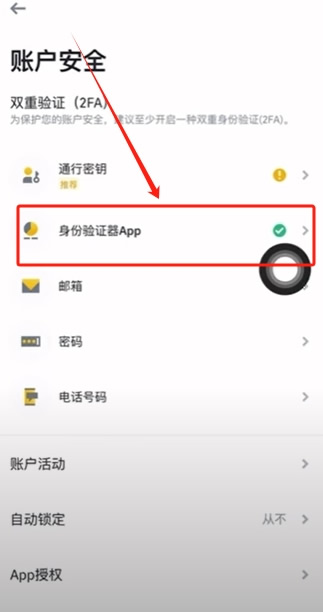
After the authentication is completed and the security settings are completed, we can buy coins on Binance.
5. Buy USDT, sell USDT
Buy USDT:
1. Click [Add Funds] on the Binance homepage and select [C2C Transaction].
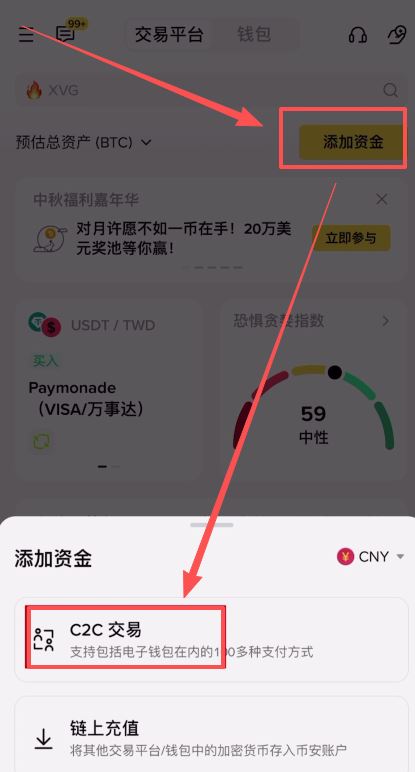
2. For novice users, it will ask us "Have you ever used C2C transactions?", I will skip the novice guidance and select I have experience.
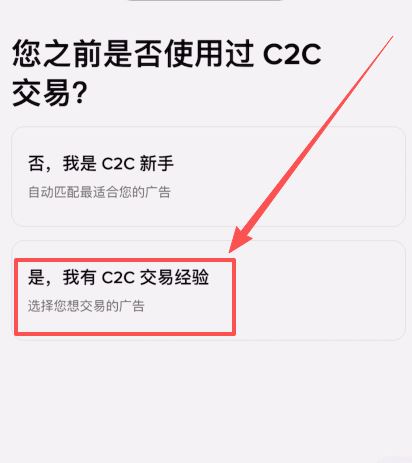
3. After entering, you can see that there are express zones, self-selected zones, strict zones and bulk zones.
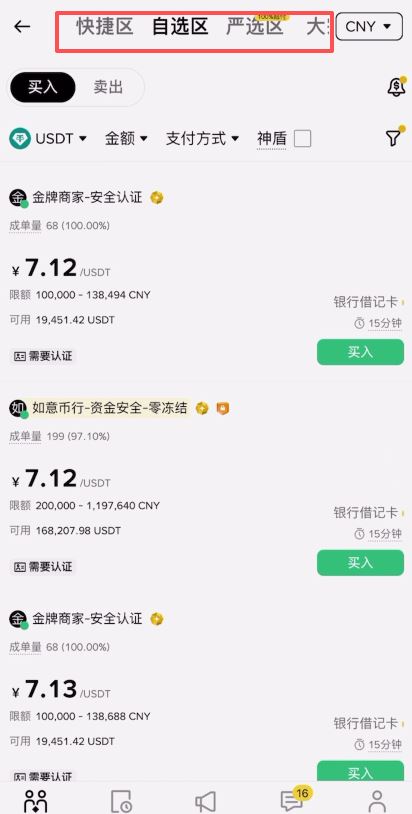
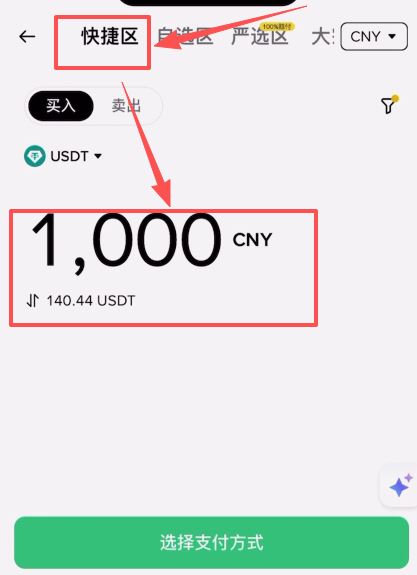
4. As the name suggests, the quick area is more convenient and fast. We directly enter the amount of RMB we want to buy, and then we can buy the corresponding amount of USDT. It calculates for me here that I can buy about 140.44 U for 1,000 yuan.
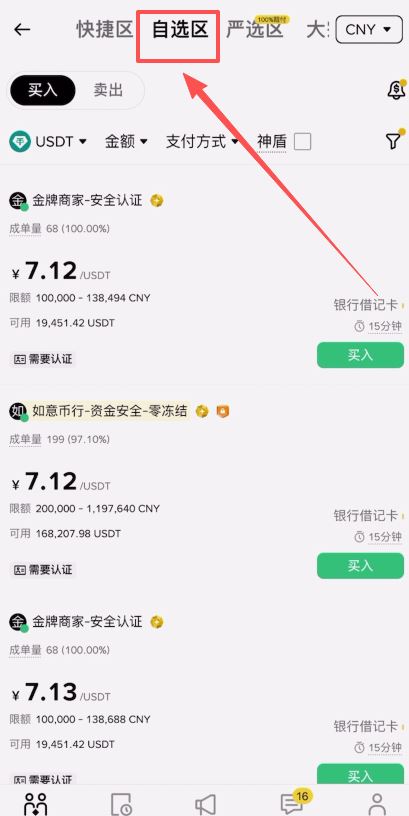
5. The "self-selected area" is a little more complicated, but the self-selected area, the strict area and the bulk area are relatively similar. The difference is that the large area is specifically designed for large-amount transactions, and its limits are generally relatively high.
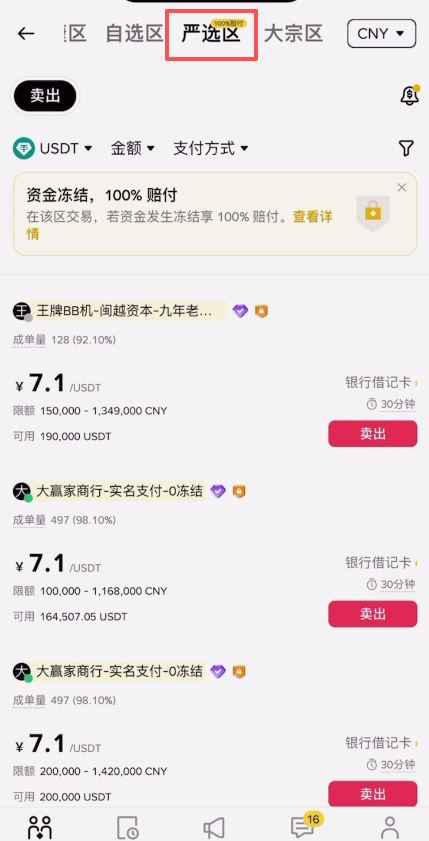
6. The "strict area" is equivalent to the selling area of the self-selected area. The strict area only has the function of selling, which means that it is specifically designed for withdrawals. We can see that it has written a 100% compensation for us here. Because the merchants in Yan District are all Aegis merchants, they have deposited a large amount of deposits on the platform. If something goes wrong during our transactions with them, this will cause our funds to be frozen, our accounts to be blocked, etc. It will compensate us 100%, so when we withdraw money, it is safest to use this strict area.
7. When depositing money, we can directly use the buying function in this self-selected area, and then screen some more reliable merchants by ourselves. How to filter? First, we can filter the amount we want to buy, for example, I want to buy 1,000 RMB USDT, and then filter our payment method, for example, I want to pay using WeChat, click [Confirm].
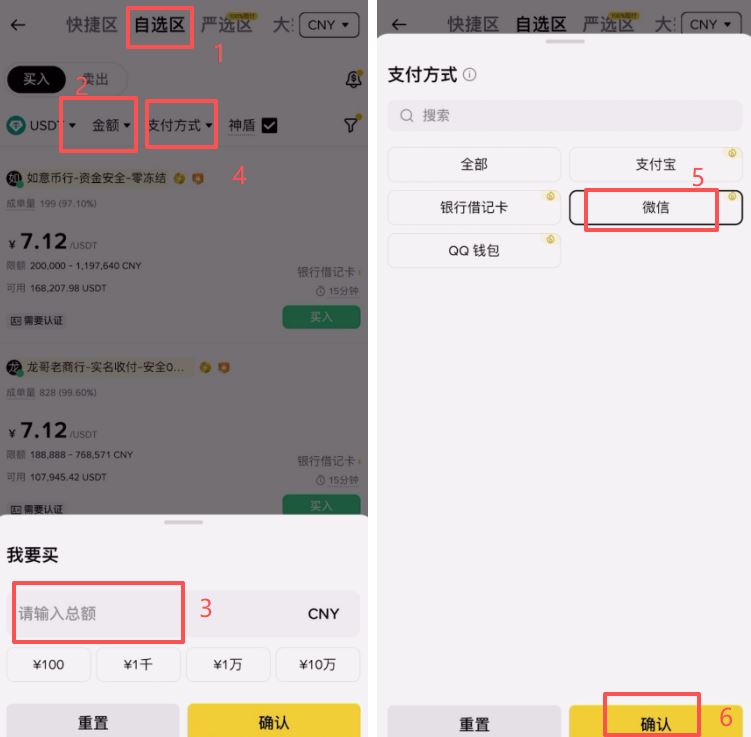
8. We check this Aegis, so that we have a relatively high safety factor.
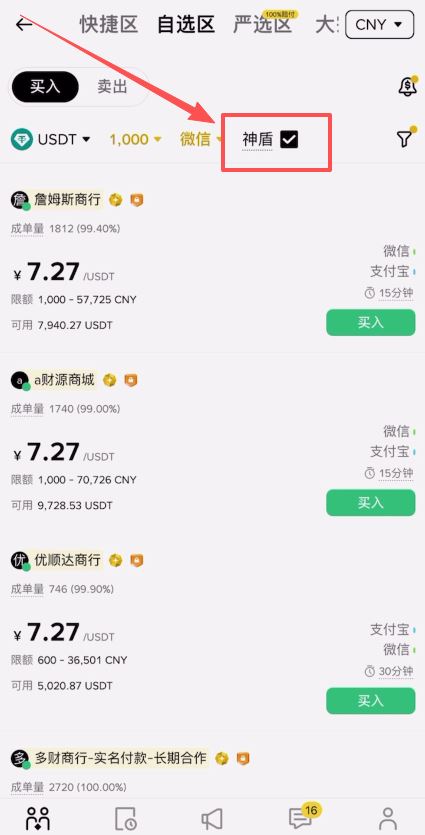
9. Let’s directly look at the following merchants that meet our conditions. The higher the order volume and order rate, the better. Then we click on his homepage to check when he became a merchant. We can see that this merchant's account has been created for more than 1,200 days, and the first transaction is relatively long ago. We need to look for merchants that have been registered for a long time, at least for more than half a year. Because the longer his account survives, it proves that his assets are safer, and he has done so many transactions without any problems. After confirming the transaction with him, we click [Buy] here.
10. After entering the amount we want to purchase, it calculates for us that we can receive 137.55 U, and then click [Place Order].
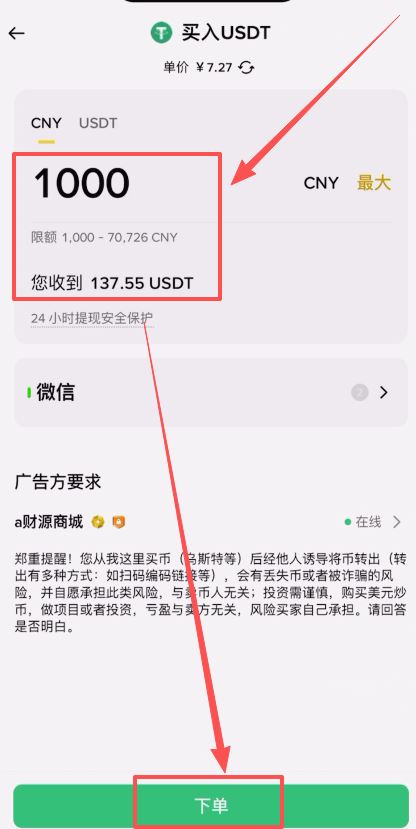
11. At this time, our order is generated, and the merchant's name, WeChat account, and payment QR code will be displayed to us. At this time, we need to leave the platform and add his friends in WeChat, or use the scan function to transfer money to him. After the transfer is completed, remember to take a screenshot to keep the voucher, then return to the platform and click [Upload Payment Proof].
12. Upload the screenshot we just took here, and then click [I have completed the payment, notify the seller]. In this way, after the seller receives the money, he will release the coins to us. In this way we have completed a deposit process.
13. However, I would like to remind everyone that you must not make any remarks during the transfer process. You must also use your Binance real-name name, WeChat account or Alipay account under your name to transfer money to others. These are the basic requirements for some transactions. Of course, if there are any problems during the payment process, you can also click [Chat] to communicate with the merchant.
14. After buying USDT, we go to [Assets] in the lower right corner and we can see that he has many accounts here.
Tether (USDT) Review
Most people think USDT is usable, but they still need to be aware of the risks.
Dcard netizens’ opinions PTT netizens’ opinions on Tether (USDT) News Compilation
In recent years, Tether has been closely watched by investors, researchers and the media due to the controversy and turmoil behind it.
Here is a summary of these important news:
Sorting out 1. Issues of financial auditing and real reserves
Tether promises to conduct regular audits to ensure that every USDT is backed by one dollar. However, the accounting firm Friedman LLP, which was originally scheduled to perform the audit, chose to discontinue cooperation in 2018 because the financial information provided by Tether was too simple.
Later, although Tether obtained a report from Freeh Sporkin & Sullivan indicating that it had sufficient bank deposit support, detailed financial data has not been made public. In fact, in 2019, Tether even admitted that only 75% of its reserves were backed by U.S. dollars.
Summary 2. Charges from the New York Prosecutor’s Office
The New York Prosecutor's Office revealed that Tether had no real U.S. dollar reserves for a certain period of time.
In addition, in April 2019, the prosecutor's office accused Tether of using its own reserves to fill an $850 million funding gap of its parent company.
By 2021, the two parties reached a settlement, and Tether agreed to pay a fine of US$85 million, but did not formally admit its fault.
Arrangement 3. Concerns about market manipulation
At the end of 2017, the activities related to Tether and Bitcoin prices attracted attention.
The U.S. Commodity Futures Trading Commission issued subpoenas to Tether and Bitfinex, suspecting that Tether may be manipulating the price of Bitcoin by issuing Tether coins. Research from the University of Texas also found that there is a correlation between the additional issuance of Tether and the rise in Bitcoin prices, raising concerns that Tether may be manipulating the market.

Sort out 4. Recent price fluctuations
Tether has recently seen a massive sell-off on several trading platforms, pushing the price slightly below $1.
The chief technology officer of Tether hinted on social media that competitors (such as Binance) may be involved in this fluctuation. At the same time, some analysts also pointed out that Binance may be planning a market attack on Tether, trying to improve the status of its own stable currency through various means.
Tether (USDT) FAQ Question 1. The stable currency UST has plummeted. Is USDT still safe?
The stablecoin TerraUSD (UST) decoupled from the US dollar and its price plummeted, which in turn had a huge impact on the entire cryptocurrency market. This incident has attracted the attention of many investors, and many people have wondered: Is it possible that USDT will follow the same path?
First, we must understand the classification of stablecoins. Stablecoins are divided into three categories: legal currency stablecoins, cryptocurrency stablecoins, and algorithmic stablecoins.
Use a table to let you clearly understand the differences between the three!
Features Fiat Stablecoin Cryptocurrency Support Stablecoin Algorithm Stablecoin
describe
Directly linked to fiat currency, each issued stablecoin is backed by equivalent fiat currency or fiat currency equivalents
Backed by other cryptocurrencies as collateral, the value depends on the collateral cryptocurrency
It does not rely on any actual asset support and uses algorithms and smart contracts to regulate supply to maintain price stability.
Linked assets
Fiat currency (USD, Euro, etc.)
Other cryptocurrencies (Bitcoin,
Ethereum, etc.)
No real asset support
advantage
The price is stable and easy to understand and accept
Decentralization, reducing reliance on traditional financial systems
Fully decentralized and highly flexible
shortcoming
Centralized management is required and there are regulatory and audit risks
High price volatility and may require over-collateralization to maintain value stability
Extremely dependent on algorithm efficiency, facing complexity and predictability issues
Among them, USDT is a "fiat currency stable currency", which means that each USDT is linked to 1 US dollar. Cash reserves are maintained by TEDA Limited in Hong Kong. However, in 2021, the company inadvertently revealed that its physical cash reserves accounted for only 2.94% of total assets. Other major assets include: commercial paper, trust deposits, guaranteed loans and corporate bonds.
In contrast, UST is an "algorithmic stablecoin" whose price is entirely determined by the decentralized algorithm on the Terra protocol, without any form of physical reserves behind it. Stability depends on another token, LUNA, which is a dual-token model. When the price of UST fluctuates, this algorithm will stabilize the price of UST by adjusting the supply and demand of LUNA coins.
But it is this stabilization mechanism that only relies on algorithms that makes UST susceptible to market changes. When the value of UST continues to decline, in order to maintain stability, the price of LUNA begins to fall, and a large number of new LUNA are created, hoping to maintain the value of UST in this way. As a result, the issuance of LUNA coins increased an astonishing 328 times in a short period of time, eventually causing the values of both UST and LUNA to plummet and completely lose their stability.
Although USDT and UST are both stablecoins, their operation methods and the mechanisms behind them are very different. Therefore, the collapse of UST does not directly mean that USDT will have the same risk, but investors still need to remain vigilant about the reserve assets behind it.
Question 2: How to convert USDT into RMB?
The process of converting Tether to RMB includes the following 6 steps:
Special tip: do a small test before trading and withdrawing money to make sure everything works smoothly. In addition, try to choose an exchange with a good reputation and reputation to reduce unnecessary risks.