In the summer of 2025, Shanghai has begun operating paid "unmanned taxis".
Shanghai's intelligent and connected automobile industry welcomes favorable policies again.
On February 11, Shanghai held a press conference to systematically introduce the "Shanghai Fifteenth Five-Year Plan for National Economic and Social Development" (referred to as the "Outline"). The "Outline" proposes that Shanghai will expand the exploration and application of new technologies and new scenarios, accelerate the digital upgrading of infrastructure such as highways and waterways, and support the upgrading and application of intelligent connected vehicles.
In recent years, Shanghai’s intelligent connected vehicle testing application space has continued to expand. The "Shanghai Intelligent Connected Vehicle Development Report (2025)" (referred to as the "Report") compiled and released by the Shanghai Intelligent Connected Vehicle Testing and Demonstration Promotion Working Group shows that by the end of 2025, Shanghai has opened a total of 3,173 5,238.82 kilometers of autonomous driving test roads, covering about one-third of the city area.
According to industry insiders, these test roads are mainly concentrated in Pudong (except some roads in Lujiazui), most areas of Jiading, Fengxian Nanqiao Town, Minhang Hongqiao Town, Dalinghao Bay, Xinzhuang and other areas.
Each district has its own characteristics in terms of application testing positioning. Pudong New Area has basically opened the autonomous driving test roads to the entire area, providing a multi-dimensional real test verification environment; Jiading District and Lingang New Area continue to improve the test road network and scene supporting facilities to ensure smart rental, smart buses, Multiple application innovations such as smart heavy trucks have been implemented; Fengxian District focuses on upgrading smart-driving BRT buses and creates exclusive application sections; Minhang District opens Hongqiao hub and cross-district test channels to create an innovative demonstration area for connected transportation hubs and build a multi-functional smart travel system.
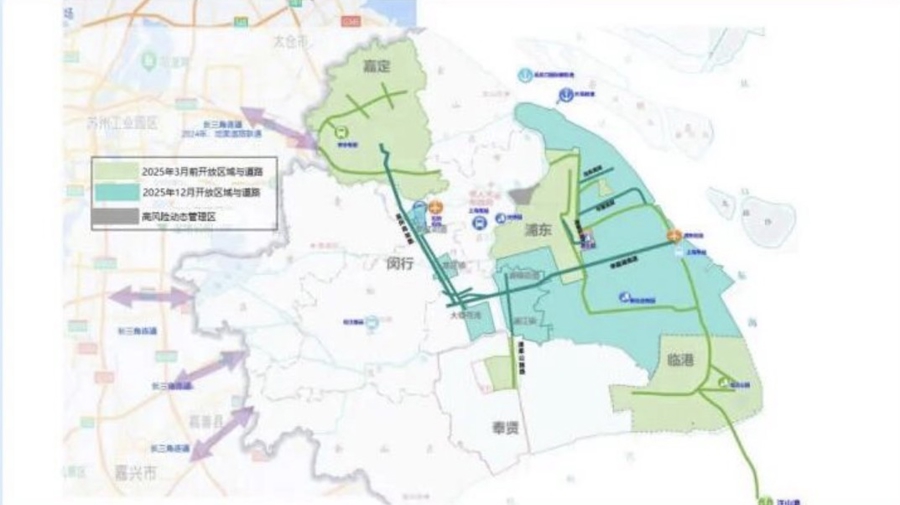
Schematic diagram of Shanghai test road (screenshot of Shanghai Municipal Transportation Commission website)
Among all application scenarios, the one that attracts the most attention is the intelligent network taxi, which is often referred to as "unmanned taxi". In July 2025, at the World Artificial Intelligence Conference, Shanghai issued the first batch of intelligent connected vehicle demonstration operation licenses. Since then, many batches of licenses have been issued, and companies such as SAIC Zhiji, Baidu Zhixing, Pony.ai, and WeRide have all obtained licenses and begun operations. Obtaining a demonstration operation license means that the company can provide taxi fare collection services with no driver or driver in designated areas (some models still have safety guards as co-pilots).
Since Pudong has basically opened its self-driving test roads to the entire area, many citizens have been able to hail "unmanned taxis" in the city center. Dai Dunfeng, the public relations manager of Pony.ai, said: "After we obtained the demonstration operation license last summer, we immediately deployed operating vehicles in Pudong. Now the number of pick-up and drop-off stations has increased from more than 20 to nearly 400. Passengers can find our driverless taxis near Century Park and Century Avenue."
According to industry insiders, there are three main types of intelligent connected vehicle license plates currently issued in Shanghai:
Driverless intelligent connected car road test licenses to be issued starting in 2023 – with this license, driverless vehicles can be tested on the road.
Self-driving intelligent connected car demonstration application licenses will be issued in 2024 – companies can start self-driving taxi services, but the main driver needs to be equipped with a safety officer.
Intelligent connected vehicle demonstration operation licenses will be issued starting in 2025 – truly realizing "unmanned taxi" charging services.
Currently, these three licenses and operating models are being advanced simultaneously. The "Report" shows that in 2025, Shanghai issued a total of various license plates to 932 vehicles from 41 companies, with a test mileage of more than 34.55 million kilometers and a test duration of approximately 1.88 million hours. Among them, 192 vehicles from 13 enterprise consortiums obtained demonstration operation licenses and completed approximately 556,000 orders. By orderly promoting the testing and application of intelligent connected vehicles, it can help intelligent driving companies better collect real-world data and realize the iteration and popularization of intelligent driving technology.
During the "15th Five-Year Plan" period, Shanghai's intelligent connected car applications will move towards a new stage of development of "full domain integration". The "Report" proposes that Shanghai will build a development paradigm in which regulations, standards and open roads coordinate and promote each other, create a test and demonstration circle around the central city, and form a multi-level scene layout of "the whole city is a game of chess". Through large-scale, multi-level real-life scenario opening, we can expand the scope of autonomous driving on demand, provide a practical basis for forward-looking system innovation, and support the normalized and large-scale operation of L3 and above autonomous driving functions in complex scenarios.